A family memoir
My Life
1935 – 2026
A consolidated edition, combining the typed memoir with the surviving manuscript pages and transcription. Sections missing from one source have been filled from another; passages common to more than one source appear once. A few short gaps remain where pages were not recovered, and are marked where the narrative jumps.
My Life
My Life
Introduction
I am writing this because I want to share my life with you, everything that I can remember.
For those of you who may read this in the distant future, I am pleased to share the good, the bad and the ugly of my life with you.
In telling my story it is inevitable that it means rummaging through other people’s lives. I thought this was all going to be about me but once I started writing I realised that it had to include my parents and other members of my family and friends.
As this is written for my family and my children’s children, I hope these pieces of my history will be worth recording.
Our family know so little about our antecedents that I want to ensure that the world I have lived in is available to subsequent generations.
Even our name ‘Delingpole’ is a closed book. Is it a corruption of De La Pole or something entirely different? I think we should try harder to find out.
My Life
Let Me Introduce Myself
Before I launch into telling you about my life story I thought I’d better tell you a little something about myself. Some of it you may already know, but some of you may come from future generations and know very little, if anything, about me.
I am Malcolm Hugh Delingpole now aged 76 with two marriages behind me and a few relationships.
I don’t call them ‘failed’ marriages because both were ‘happy’ a lot of the time and I now have 5 delightful adult children.
I went to a horrendous boarding school during the war. This left its scars, but I adored my parents and sister and was very happy at home.
I spent 4 years in the RAF and then rejoined the family business Delson & Co Ltd in Alvechurch, Worcs.
My Life
My Vital Statistics!
Here are some basic facts about me which might be of interest, at least I hope so. I have bunched them together here because they don’t really fit in anywhere else!
My eyes are blue. I am 5ft 8 ins tall. I weigh 13 stone. I am right-handed. Size 44 jacket.
Size 8 1/2 shoes.
My Life
Religion and What It Has Meant to Me
As a young man my religious faith was very important to me. I went regularly to church on Sundays when at home and found this comforting. At school this was compulsory, but I was quite happy to do so.
In the RAF my social life centred round Hong Kong Cathedral.
The Dean, ‘Freddy’ Temple and the Chaplain, Rev ‘Jimmy’ Frowd provided a glimpse into a world not dominated by RAF discipline.
‘Freddy’ once left me in charge of single-handedly entertaining all four Bishops of South-East Asia.
Later in life, as the Church became split over homo-sexual priests and women bishops I began see it in a quite different light.
I saw incredibly fallible human beings with their own agenda.
I still believe in Christ and his teachings, but I think every ‘church’ distorts his teachings to suit their own purposes.
Since earliest times man has sought something external to himself to worship.
Marx said that ‘Religion is the opiate of the masses’. It would now seem that ‘Climatism’ is replacing Marxism as something in which the masses could believe.
I think this false doctrine should be fought as vigorously as possible.
I was born into a non-religious family. It didn’t really feature in my life until I went to school and we had assemblies. My family encouraged me to go to church, where I was a firm believer.
My Life · Chapter 1
Hello World Here I Come…
The world was a very different place when I was born. There was a king on the throne and Britain had an empire, shaded in red on the map, that went all around the world.
I have seen so many extraordinary things happen in my life. Things that are now taken for granted, such as cars and aeroplanes, were rare and television and computers were on the distant horizon - if they were imagined at all.
This journey through my life is not about technological development, but inevitably my story includes how such things impacted on my life and my family’s life.
It’s hard to know where to start. Should it be the most important events and relationships in my life? Should it be my greatest heartaches? Should it be my greatest triumphs? Or the moments in my life that had a profound effect on me and made me the person I am now?
Well, you will have to wait for those moments because I am going to start at the beginning.
So, I’ll start 76 years ago. I was born on 1st March, 1935 at some time on that day. I have no idea how much I actually weighed at birth but I look a bit scrawny in my baby photos.
My mother’s name was Ethel and my father was Ken.
About My Birth
About My Birth
Having a baby was very different when I was born. There were no birthing pools or male midwives for a start! And fathers, well, they weren’t encouraged to be a part of it in the way they are today.
I was born in hospital, like most babies at the time. There was some doubt as to whether I would live as I had Pyloric Stenosis (a bowel blockage) which had to be operated on when I was 2 months old. I was baptised in hospital with only a nurse as god-mother. I do not know her name.
I very much doubt that my father was present at my birth.
I was given the name Malcolm and Hugh. My father was passionate about motor sport so I was named after Sir Malcolm Campbell. I still have his autograph which I obtained many years later.
My Family
My Family
What is it they say? You can choose your friends but you can’t choose your family. Well, I would have chosen my family every time.
My parents were loving and kind, but they kept a disciplined household. I felt safe and it gave me a great start in life.
I am lucky, I was the first-born. Although it is a shock when the others arrive there is nothing like being the first. They say that first children are good at taking responsibility and have more successful careers.
My sister was not born until I was 8 years old. So for many years I felt I was an only child.
I was the adored elder brother right up to the time I returned from RAF service in Hong Kong.
After that, I became a slightly more fallible human being!
My Father and His Family
My Father and His Family
While this is the story of my life and not a family tree or the genealogy of our family line, it would be wrong to leave out what I know about my parents and their parents.
I am fascinated by family history and so forgive me if I cover this chapter in some detail. I hope it will interest you as much as it interests me. Let me start with my father’s family.
My father Kenneth Court Delingpole. His father was William Harry and his mother, my grandmother, was Amy. Her maiden name was Cotterell.
My father came from an argumentative rather aggressive family which may explain his own character. My father had a lonely childhood as his parents’ marriage did not last long.
His childhood home was in Eastcote Hall, Warwickshire. It was a big house with lots of rooms, it faced south and always seemed to be light and airy.
It’s difficult to know what kind of person my father was as a young man. To me he was always a serious chap with my best interests at heart. I can’t imagine him courting or dancing or being brilliant at sport because that was all before I was born.
As for his education. My father boarded at Warwick School, which he hated. Someone dropped a flower pot on his head from an upstairs window, I’m not sure if this affected him. He talked of eating ‘bread and scratch’: the margarine was placed on the bread, then ‘scratched’ off!
As my father worked in his father’s business, he was not poor but cannot have had much of a home life as his parents were separated. His mother did not show him much affection but her sister ‘Arny O’ did. I think ‘Arny O’ was the one ‘Grandpa Delingpole’ SHOULD have married, with all that that implies!
Before I went to boarding school, I went briefly to ‘Arny O’s’ for ‘coaching’ as she had been a teacher. She seemed severe but appeared to like me.
My Father’s Parents
My Father’s Parents
I got to know both of my father’s parents pretty well, but as they’d parted many years before they were two individuals who needed my parents’ help. We used to take Grandpa Delingpole on holiday, and go to Grandma Delingpole’s during the Blitz.
I wasn’t close to my grandfather (my father’s father) he always had a rather severe side to his character and as a child I was a bit scared of him. My grandfather’s full name was William Harry Delingpole. His date of birth was 13th July, 2011.
Pictures of my grandfather show a spirited and fit looking young man. He really was a handsome chap. My paternal grandfather was a ‘ladies’ man’. He and my grandmother parted soon after my father was born, but they never divorced.
He had quite a sense of humour, went on many cruises and played bridge. He lived by himself in a flat at Pitmaston Court Edgbaston Birmingham. My mother bought his clothes for him. At week-ends he went to his sister ‘Aunt Maud’s’ in Stratford-on-Avon. I never saw him smartly dressed, although as a younger man I think he was quite ‘dapper’.
He was always Grandpa Delingpole, as I now am to some of my grandchildren. He played golf and bridge but he was busy building up a business in Birmingham in bolts and nuts. His partner John Burton who ran the scaffolding and flange making side at another factory in Old Hill, Rowley Regis, Worcs.
The company was of course, called Burton Delingpole & Co Ltd. However they got rather careless with their book-keeping, the Inland Revenue made an issue of it and all the Directors went to jail in Winson Green prison. My grandfather used to say of this period ‘When I was on the Gold Coast’!
My father started Delson & Co Ltd in parallel, in case customers would cease dealing with the ‘stigmatised’ company.
My grandfather had an excused occupation. He did not serve as his firm were engaged in War Work.
His brother was a Sgt Major posted to the West Indies. He struck an officer and was dismissed. My grandfather used to help him financially.
I found Grandpa Delingpole to be a much stronger character than my father, when we toured Europe in the Allard car (more later) he was great company.
My grandfather married Amy.
From my point of view she was an affectionate and kind grandmother, the kind of granny anyone would love.
Grandma Delingpole lived in a bungalow in Pickersleigh Rd, Malvern, Worcs, near where I live now. At the height of the ‘blitz’ my parents would leave me with her. She would take me up on the Malvern Hills to the Kettle Sings, a cafe which is still there, and once to see the Lanchester Marionettes, which impressed me, as there was little entertainment then.
I think she was a better grandma than a mother!
I have described life for my father at Warwick School. He hated it even more than I did, if possible!
He worked for his father initially but when my grandfather went to prison he started a new company making bolts and nuts called Delson & Co Ltd.
My mother was also involved in a company start up, DGS Ltd which made cotterpins. This stood for Delingpole, Gee and Strong, the Gee was ‘Tommy’ Gee who soon died, the Delingpole was my father and Strong was my mother’s maiden name. We later sold this business to ‘Johnny’ Lees, the General Manager, who changed the name to A. J. Lees & Co.
My father was in a reserved occupation, since he was making munitions, but served first as an ARP (Air-Raid Precautions) Warden and later in the Home Guard, where he was a corporal - his poor hearing meant he could not rise much further.
The most frightening incident of those war years was when a German land mine, dropped by parachute, landed in a tree in Hole Lane, off the Bristol Road in Birmingham, close my grandmother’s sister’s house. ‘Arny O’ as she was known. All the houses for long way round were evacuated while it was defused. Had it hit the ground she would certainly have died.
My Mother and Her Family
My Mother and Her Family
My mother’s parents, unlike my father’s, were devoted and died within a week of each other.
Grandpa Delingpole lived at Eastcote Hall, while Grandpa and Grandma Strong lived at Eastcote House, when my parents met. Grandpa Strong had a successful coal delivery business but couldn’t resist backing slow horses.
So while Grandpa Delingpole grew richer, Grandpa Strong grew poorer eventually losing the house and the business. My parents funded them in later life.
My mother’s full name was Ethel Zillah Strong.
My mother came from a big family. They all seemed to get on well and cared about each other through thick and thin. My mother was the eldest child, she had a younger brother Bill, who worked for my father all his life, a sister Nora who was a ‘land girl’ during War, never married and died of ‘sleeping sickness’ I believe, soon after the War. She also had a younger sister Mary, who also worked in one of the family businesses for a while.
They were a very close family. When one was wronged they were all wronged.
Her childhood home was in Warwickshire.
My Mother’s Parents
My Mother’s Parents
I don’t remember much about my mother’s parents. We didn’t see much of them and so my memories are a bit of a blur and sadly they died when I was quite young.
It’s a great shame because I never had that wonderful grandchild, grandparent relationship. First let me tell you about my grandfather, my mother’s father.
On my mother’s birth certificate, her father is described as a Coal merchant. My mother’s father’s name was Sidney Strong.
He was a devoted husband but he could not resist a ‘flutter’ and eventually lost everything, except my grandmother, of course.
I did not get to know Grandpa Strong anywhere near as well as Grandpa Delingpole. He and Grandma Strong had each other whereas we would often take Grandpa Delingpole on holiday or visit to see that he was OK.
My mother had one brother, and two sisters. I have described mother’s siblings elsewhere.
So, my mother was born into a rich family with no money worries which was a privilege that she never took for granted.
Going Back Even Further
Going Back Even Further
Going even further back in family history takes quite a lot of research and so some of what I know is set down here. The thing about working on one’s family tree is that it can go on forever and so I have included what I know at the time of writing this book.
One of Grandma Delingpole’s forbears was Abraham Wivell. He was a portrait painter and invented the first canvas tubular fire escape which was at one stage in the Science Museum. I have seen it there.
Photograph: Strong family - Ethel in the middle
My Life · Chapter 2
My Early Years
And so that’s my family background and now on with my story. It’s funny looking at photographs of me and my family when I was very young. It’s like looking at another world. The one thing those pictures never fail to do is bring back memories. Some happy, some sad.
As my story unfolds you will learn about those memories.
I’ve told you a little about my arrival into the world but I thought you might like to hear more about those early days.
Of course, I don’t remember any of this, I was too young, but from what I have been told by family and friends I will fill in as much as I can. I was born into a small family who loved and depended on each other. I have been told that I was a sickly baby.
I don’t know if you want to know all the details but just in case you do. As far as I know I did have a comforter. I always like to sniff a newly ironed handkerchief.
We lived at 46 Green Meadow Rd, Selly Oak, Birmingham. It was a comfortable middle-class four bed detatched house with largish garden. We lived there until I was 7 years old. The thing I most loved about that house was our ‘maid’ Irene and ‘Billy’ our wire-haired fox-terrier. But its downside was it was during the Blitz and things like Cadbury’s drinking chocolate disappeared.
I was discouraged from going outside to watch aerial dogfights ! I was sent away to boarding school in Shropshire at the age of 6 because my parents thought that Birmingham would be blitzed as badly as London or Coventry.
Our home was stable. I had the most kind parents. My father was busy working and providing for us. Photographs of him at this time show a kindly man.
When I was a baby I have been told that my father rarely spent any time with me. And my mother was the most tender mother. She was a very pretty woman. At this time of my life she was a full-time mother.
As a baby it would have been impossible to know skills I would develop as I grew up, but I believe my personality has largely stayed the same. I was a quiet serious child, always watching what was going on around me.
Decade of My Birth
Decade of My Birth
So, what was it like growing up in the 1940s? Well, of course the war coloured every moment of our lives. There was rationing of nearly everything. Our food, our clothes and if you were lucky enough to have a car or a motorbike then the petrol was also rationed. In fact surveys now show that we were healthier then, thanks to the rationing, than we are now!
We lived in fear that we would be bombed or invaded and some of us were sent into what our parents hoped would the safety of the country, but some of the evacuees - which is what they were called - had the most terrible times with their new families. After the war some children told of the most dreadful abuse.
But for those of us who avoided that, life as a child was like life for all children. We made the best of it, played around the streets until we heard the siren warning us of an air raid when we ran in to hide under the kitchen table or under the stairs. And just like every generation before and after us, either loved or hated school.
I loved home and felt very protected, but when at the age of six I was sent away to boarding school in Shropshire my world fell apart. My mother could only get to see me once a term because of petrol rationing.
The headmaster R. V. Rigby was a brutal sadist who thrashed boys at the drop of a hat. I was a real ‘goody-goody’ but was frequently beaten for things I’d never done.
There was a time when another boy and I got lost on a walk and made our own way back early, but we were still beaten.
We had to go to bed at 5 pm (in daylight) due to ‘double summer-time’ and were not allowed to leave the ‘dorm’. The bucket in the middle of the floor was sometimes ‘missed’ in the dark, leaving a pool of ‘wee’ round it.
Nobody really cared what their children were going through, adults were in fear of their lives and just hoped their children might survive them.
Headmasters could get away with almost anything. I doubt if ‘Riggetts’ was a paedophile, just a sadist !
Early Childhood: 1 to 5 Years
Early Childhood: 1 to 5 Years
As a small child I did not realise that we were wealthier than most, we had a ‘maid’ Irene who looked after me. I remember my parents had a good social life. With their friends the Mays and the Mansells my parents shared their enthusiasm for sports cars.
I remember that both my parents smoked, my father cigarettes and a pipe occasionally.
They drank ‘gin & orange’ or ‘gin & it (Italian Vermouth)’, as I don’t recall Indian Tonic Water being around then.
As I have explained life all those years ago was so very different from today. For one thing children were children and not tiny grown ups. We looked different from our parents, we were not just wearing smaller versions of what they wore.
In these early years one family story stands out. I visited Mrs Pickup who lived 3 doors away, she had a pet pekinese who ‘snuffled’ a lot. However she had had these dogs before and had either had them skinned or stuffed. I was horrified! The best thing about these very early years was feeling that my parents loved me. Though the War worried them I thought it was very exciting, especially picking up bits of ‘shrapnel’. Other than my mother and father, the most important person in my life was our ‘maid’ Irene who doted on me.
For some people their home, street and town defines them, for others it is just a place with few emotional ties. But regardless of how one feels, it is inevitable that where you come from has an effect on your life.
As I said before, my earliest days were spent at No 14 (I think) then later No 46 Green Meadow Rd, Selly Oak, Birmingham. We lived in a largish comfortable 4 bed detached, with a garden where my father created a pool. My interest in all things aquatic were stimulated at this point.
We started by hiding under the stairs during air raids, then built an ‘anderson shelter’ DOWN the garden, soon to be replaced by a more substantial one, adjoining the house, where I frequently slept in my ‘siren suit’. We lived in a very middle class area. Everyone looked after their gardens. It was a quiet road in a well-to-do suburb with plenty of trees. A purely residential suburb, all our shopping was done in Selly Oak so a car was needed.
Cakes etc we bought from Mrs Paling’s. Mother bought her clothes from ‘Jean Muir’ next door.
The biggest difference between where I lived then and where I live now is that I now live in a small flat by myself, so really there is no comparison.
So I had arrived. At this time my father was working in the family business. He was running the family business in Birmingham. (Delson and Co) but the earlier family business Burton, Delingpole & Co was run by my grandfather in the same premises.
At home he loved his pool, rockery and garden and always had a sports car. My mother also worked in the family business on a capstan lathe. I once asked her why she went to work, she answered ‘to make money’.
One day I went into Birmingham with my parents to see this, hoping that I would see new coins coming off her machine. Instead I found she was making ‘insulators’ for mines out of a toxic material called ‘tufnol’.
We had this ‘maid’ Irene who had a boyfriend named ‘Mac’ who was a policeman. They married and she left. ‘Maids’ were not ‘expensive’ in those days and both my parents worked in the business.
I thought I would describe a typical week at this time in my life to give you a sense of what it was like for me as a child. I was collected by another parent each day, taken at first to ‘the missionary guest house’ (infant school) and later Weoley Hills School.
I remember my parents anger when they realised that Douglas Barwell was still picking me up and taking me to school even though his son Nicholas was ill and so not attending school. I had failed to tell them and they were highly embarrassed when they found out.
I remember little about either school except that there was a boy called Braun who was a Jewish refugee. There was an almighty row one day when a woman called him a ‘little nazi hun’, because all he could speak was German. Even at that tender age I realised how unfair she was.
Billy the dog was a wire-haired fox terrier whom we loved. Always thereafter this breed was referred to as ‘William dogs’. You rarely see them now.
My Siblings
My Siblings
I have never understood people who don’t get along with their siblings. For me, they have been the vertebrae of my life. They have always been there, steadfast and strong, my companions in childhood and my confidantes in adulthood. I think it is a unique relationship, an untold pact that one would always look after and look out for the other.
My sister is 8 years younger than me. So I was an only child at that time.
Childhood Toys
Childhood Toys
Nowadays it is all X Boxes and computer games. When I was a child there were no such things nor were they dreamed of. We had teddy-bears and wooden toys to push around. But they gave us just as much pleasure. In fact, one of the things that never ceases to amaze me is how much fun a child can have out of an empty cardboard box!
I loved a small scruffy teddy and when offered a larger, more pristine one, I refused it. I always like a freshly-ironed hanky to sniff when I went to bed. (Still do, I now realise !)
My Life · Chapter 3
The School Years
There was nothing about my education that I enjoyed. I hated every moment and couldn’t wait to escape through those school gates to my real life. A new life where I could feel self respect and enjoyment, not constant humiliation and fear.
Of course the teachers were not all tyrants but looking back it just feels like that. I honestly am struggling to recall a happy moment in all those years.
About my very first school the Missionary Guest House I remember very little. The next one the Weoley Hills School I only remember being collected and delivered. I had a single term at the day part of Edgbaston Preparatory School, before being evacuated to the ‘boarding’ part in Shropshire. I recall that on arrival we had roll call, after hearing our name we had to say ‘Adsum Sir’. I thought this sounded too much like ‘AbsentSir’.
Earliest Schooling
Earliest Schooling
I can’t remember a day of nursery school. Apparently I went, but I can’t remember any of it. Perhaps I did not like being left and I have blocked the memories from my mind.
The very first school I went to was Missionary Guest House, Bristol Rd, Selly Oak. It was a state run school. I was four maybe years old when I first stepped into the place. I have no memories at all of the school or its staff.
I used to play with Keith Hudson and his cousin another Hudson. I remember sitting on top of their flat-roofed air-raid shelter writing down everything we saw in a large unlined drawing book.
Primary/Preparatory School Years
Primary/Preparatory School Years
I know I shouldn’t, but I hated primary school with a passion. Hate, such a strong emotion, but it’s the only way I can describe how I feel about those drawn-out, excruciatingly horrific days. Feeling excluded, socially unacceptable, discarded, not worth the trouble.
I still don’t know where I went wrong, perhaps I wore the wrong clothes, said the wrong things, perhaps I could have helped myself more, but it was like a prison for me. Those years stretched ahead like a never-ending nightmare.
When I was five I went to Edgbaston Prep School Birmingham. It was a prep school. My parents found it easy to pay the school fees. I can’t remember much about ‘Hallfield’ the day section of this school as I was soon ‘shipped off’ to ‘Sidway, the ’boarding’ part in the wilds of Shropshire, except saying ‘adsum sir’ at the daily roll-call.
My father did give Hallfield his magnificent butterfly and birds egg collection. I’m not sure why. We wore vivid red and green striped blazers, far too distinctive! The parents with cars did rotas to get us to school.
When at Sidway (in Shropshire) I would play outside if possible and developed a love of nature.
I can’t think of anything positive about the school itself.
At Sidway I remember frequent un-merited beatings, awful food and feeling of helplessness. I would escape into a fantasy world. My favourite subjects were Nature Study and possibly Scripture.
Peter Ward was the only ‘friend’ I remember. As far as the rest were concerned I was younger and smaller and was duly bullied.
When I was six I went to a new school. I now attended Sidway (Edgbaston Prep in Shropshire)
I had to have a new uniform. The new school uniform was the same Red and Green striped blazers. The school was a country mansion, with dormitories holding 5 or 6 boys.
What I remember most about this school was the brutal headmaster. Boys who had ‘been naughty’ on a Monday had to wait until the headmaster arrived on Friday night from Edgbaston, to be beaten.
Today’s children regard this as unbelievably callous, but our generation who lived through those ‘brutal’ times have gone too far the other way in protecting our children from almost any punishment, certainly not a physical one. Thus, today’s kids know that they’re ‘untouchable’ and abuse this situation.
My Life
Here Are a Few of My Favourite Things
Music
Music
I’m no music buff but there have been songs and tunes that have become the music track of my life. I thought you might find that my choice of my top ten would tell you more about who I am.
High Noon
Hernandez Hideaway
Cherry pink & apple blossom white
24 hours from Tulsa
Annie’s Song
There’ll be bluebirds over the white cliffs of Dover (Vera Lynn)
Ravel’s Bolero
Lilli Marlene
If I were a rich man (Fiddler on the roof)
Growltiger (Cats)
I had very few happy memories, unless I was ‘communing with nature’.
I was bullied and occasionally beaten up for ‘twitting’. As mentioned the Head needed little provocation to beat the boys.
The meals were universally awful, except on the days when we had rabbit, which were kept as pets and then killed and eaten. Rabbit was (and is) delicious.
We had a boy called Cariss who hated cabbage and refused to eat it. This provided a welcome diversion, and ‘cabbage’ became his nickname.
I changed school again. The Lickey Hills School in Rednal, Worcs was a blessed relief after Sidway. It was not far from home, I was not the smallest boy in the school and the headmaster Mr Healey was much more civilised. His son David and daughter Diana were also at the school.
I thought you might be interested to know what a typical week was like at this time. Holidays were always idyllic as I was away from school. We had hens to feed and eggs to collect. I vividly remember writing 4/4/44 on an egg on that date, also my father asking my mother if there had been anything on the news. She mentioned this huge bomb that had been dropped on Japan. My father thought she must have misheard, so we eagerly clustered round the wireless for the next bulletin
I hated all sports at school. Football more so than cricket as it was played in the winter cold. Walks were fun and still are.
Christmas as a child is always memorable, be it the best Christmas you ever had or the worst. The highlight of the festive season was the arrival of the hand-bell ringers, already quite ancient they only lasted a few more years.
They would reach our house well fortified with brandy and barely able to play! Because I loathed boarding school so much my memories of Christmas at home were always good happy ones.
Although I personally was quite ‘devout’ attending our local church every Sunday for Mattins, which of course was also compulsory at boarding school, my parents only went at Christmas and at Easter.
Mrs Hodgins, the Rector’s wife sat at the back of the church at the end of the pew and ‘clocked’ everybody in. Peter Merry a churchwarden would give me a lift.
The Rector, Rev Hodgins, along with the local bobby and Doctor Vollam lived in the village and all well respected. The bobby always received a monetary gift from the wealthier villagers, until PC Thornton Pett arrived, whereupon he told us that he was ‘amply rewarded for the job he did’. We never saw it as corruption.
Learning to Read and Write
Learning to Read and Write
I love reading. I love escaping into another world with a novel or learning about people and things that I had never imagined when I delve into non-fiction.
I found learning to read came naturally. I have forgotten how I learned to read!
The books and comics I loved to read were Tiger Tim’s Comic and my earliest book was ‘Little Black Sambo’, now sadly distinctly ‘politically incorrect’, also the ‘Cock, the Mouse and the Little Red Hen’.
I graduated to Enid Blyton’s ‘Shadow the Sheep Dog’ and then the ‘Famous Five’ books..
I didn’t have any trouble learning to write. Again I forget who actually taught me. I am right-handed, but at school I had one of the very first ball-point pens, of which I was very proud it cost 36 shillings (£1.80), a huge sum in those days. Sadly it ‘burst’ in my pocket and ruined my jacket!
The Teachers
The Teachers
Winston Churchill said “My education was interrupted only by my schooling.” And that is how I feel about my teachers. They drove the joy of learning out of me for many years. But, as I got older, I loved learning new things so they didn’t quite succeed in making me hate education.
We had one teacher who was waiting to join the ‘Black Watch’. He made us sit with our palms face down, hands outstretched on the desk. The slightest smirk and he would bring the sharp edge of a ruler down on one’s knuckles.
I suppose our teachers must have been in their twenties but they always seemed very mature. During the war we had some quite inadequate teachers, but they were soon ‘weeded’ out by their peers.
11-Plus, or How the Next School Was Chosen
11-Plus, or How the Next School Was Chosen
The 11 Plus exam was unheard of, our only exam other than in-school exams was Common Entrance at the age of 12/13.
The only exam we were going to have to take was the ‘Common Entrance’ exam to get into our chosen Public School.
If a boy was deemed not bright enough to get into a ‘good’ public school there was always one further down the scale that would accept him, particularly if he excelled in any sport or at music.
Nobody was concerned about passing the examination, Bromsgrove was not very academic and I was quite bright. So taking it was a doddle. I was always better in an exam situation. I was pleased to get in, but never had any doubts.
Common Entrance Examination
Common Entrance Examination
It was just assumed that I would go from my prep school to Bromsgrove (Public) School and Common Entrance was the route whereby this was achieved.
My parents could easily afford this and I thought I was bright enough to get in.
It was not until I was at Bromsgrove that I realised how much brighter I was than most who got in.
When I was nine years old I began to prepare for the Common Entrance examination. As I have said the examination was well within what I’d been taught.
Family Life: 5 to 10 Years Old
Family Life: 5 to 10 Years Old
What is it the Jesuits say? Give me a child until seven and I will give you the man? Is that it? Well, there is little doubt that this part of our lives is crucial to our future. Our happiness, or lack of it, often stems from this time in our lives.
Home life was good. My parents would go on cruises while I was away, sometimes taking my little sister.
Dad had his motor sport and my parents were happy.
My sister was born when I was 8. I arrived home to find my mother greatly enlarged. I did not know why. I was taken into the spare room where something tall and tapered was covered up. I was asked to guess, and was a little disappointed to find it was a cradle not a toy yacht!
Being that much older my sister worshipped me. Whenever she annoyed
me I would dangle her above a gorse bush and lower her in slowly. ‘Gorsebushing’ became a useful threat. I was livid when one day she turned the tables and pushed me into the pond.
We lacked for nothing.
I had few real friends at that time. We had a lovely garden with extensive grounds. In school holidays I played with my sister.
We had TV from the moment it appeared. Programmes I remember were ‘Cafe Continental’ and ‘Muffin the Mule’ with Annette Mills and Annette Crosby.
Another thing I want to tell you about from this time in my life is food. Some people eat to live and some people live to eat, but we all have to eat to survive.
Mother was an excellent cook, once a week my parents would go into the Market Hall in Birmingham, now a shell after a bomb hit it but with stalls in the open. Mother would would buy me scallops which she prepared in the shell in a white sauce, this was my favourite dish. They would also buy me a bag of winkles which I would pick out with a pin. The meal I most loved was scallops, as described above,
I know that good health is a precious gift. If you’ve got it you tend to take it for granted. But when it goes, life can become very difficult, not just for you but also for your family and friends. So, I thought I would tell you about my health as a little child.
I was not robust, I had mumps and measles while at school, which was great as it meant a few days in bed in the ‘san’. (a converted dormitory) but nothing serious.
I had had Pyloric Stenosis and nearly died when I was 2 months old and apparently had whooping cough and German Measles at the same time, but everyone expected to experience every epidemic, without lasting ill effects.
Another thing that I thought you might be curious about is pocket money, I had regular pocket money, I’ve forgotten how much. I collected postage stamps so we used to send off for ‘approvals’ which was frowned upon at school. I now recognise them as a ‘rip-off’, though buying this way to gaps in a stamp album was quite addictive.
Celebrations
Celebrations
As a family we were not that good at celebrating anniversaries, these things happened, were recognised, but not with any great ceremony.
Over the years there have been some memorable experiences at family celebrations, good and bad. For the moment I will stick to my memories of celebrations when I was little.
I remember little of my birthdays as, since I was born on 1st March, I would have been away at boarding school. I recall one early birthday of my little sister’s when she, mother and I were down at Saundersfoot near Tenby in Wales. Dad was supposed to bring the special cake which Mrs Williams was making.
Sheila was very excited that ‘Daddy bring cakey’. Daddy duly arrived without ‘cakey’ and mother had to buy one and ‘ice’ it.
At Christmas time always had a tree which my sister and I would decorate and we would gum together paper chains to decorate the house. Father Christmas always visited!
New Home
New Home
I was quite young when we moved home but my memories of both my old home and my new one and moving day are vivid in my mind. It was both exciting and frightening but because I was with my family I knew
everything would be alright.
Leaving one’s childhood home and moving to a new place, even if it isn’t far away, can be a traumatic or exciting experience. They say that moving is the third most stressful thing you can do as an adult, after bereavement and divorce, well, it can be pretty stressful for children as well.
When I was seven years old we moved to a new home. Our new home was at Shepherds Croft, Old Rectory Lane, Alvechurch, Worcs It was a house in the country was everything a boy could wish for, an orchard, a haystack, a tennis court, a kitchen garden and fields, bugs, bees, birds and butterflies!
Also of course I eventually got quite excited at the prospect of a little brother or sister. We moved because we’d bought a factory in Alvechurch and this was nearby. Both moves were because of the bombing of Birmingham.
Childhood Holidays
Childhood Holidays
Somehow looking back on childhood holidays they seem to have a magical quality to them. It’s not that they were glamorous, but the memories of the dreadful journey, crying “Are we there yet?” and the bee stings, and the cold, wet rain have faded with the years.
The first family holiday I ever remember was a visit to Ventnor on the Isle of Wight. My father sulked because he did not like the hotel and vowed to go home the following day, but by morning had decided we could stay. My fondest memory is of my first ‘waffle’, a simple delight but a new experience. Long after, on a return visit I asked for one and was told - I’ve been here 30 years and I don’t recall serving them.
As soon as we could go abroad, the Delingpole family went. We had a large 4 seater open-top ‘Allard’ with a big Ford V8 engine and were determined to tour Europe in it.
Photograph: Loading the Allard onto a Bristol Freighter at Lympne Airfield
So Grandpa Delingpole (my father’s father - William Harry Delingpole) my father (Kenneth Court Delingpole), my mother (Ethel Zillah Delingpole) my sister (Sheila Diane Delingpole) and I, drove the Allard aboard a Bristol Freighter aircraft at Lympne Airport in Kent and in no time found ourselves at Le Touquet in France. In no time, I was tasting real ‘jambon’ and realised how awful English food was at that time.
France was a gastronomic revelation; I found it difficult to understand how so soon after the War things had returned to normal there, when we were lacking so much in Britain.
We drove acoss France to Lake Geneva where we had pre-booked a hotel at Thonon-les Bains on the lake shore. We crossed the Franco-Swiss border at Annemasse where we found we were carrying far too much currency, the customs man finally gave up, spat on Dad’s passport and said ‘Bah, Anglais!’ I never understood whether it was due to dislike of the English or sheer frustration. Our relief at getting through without being fined over-rode our resentment at our treatment.
We were amongst the very first British travellers to ‘go abroad’ (no cheap package holidays then) and had to conserve every penny because of the very limited ‘holiday allowance’. Thus it was that if we saw another car with GB plates, we would wave frantically.
Shortly thereafter we were climbing the Grand St Bernard Pass but having to stop several times as the big V8 engine boiled!
This first visit to the ‘continent’ left a deep impression, which explains why I’ve always preferred overseas holidays ever since.
Sporting Life
Sporting Life
Although I’m not interested in sport as such, exercise has been important to me. At different times of my life I have done different sorts of exercise and I have always tried to keep myself fit.
At boarding school we were forced to take part in soccer, rugger and cricket, none of which I enjoyed.
Hobbies
Hobbies
Hobbies is such a funny word. They can be just the things you do when you’re not playing with your friends and not studying at school. Or they can be a passion that stays with you the rest of your life.
I had a go at all the usual stuff, including stamps. I suppose the thing about a hobby is that it is something that you like but you’re not very good at. If it were serious it wouldn’t be a hobby.
My early hobbies were stamp collecting, natural history and fishkeeping.
Later in life I assembled a valuable collection of ‘West Indies’, ‘Falkland Islands’ and ‘Ascension’ by buying at auctions. When money ran short I was able to sell most of these at a useful profit.
Natural history in all its forms has always been a ‘passion’ from collecting pressed flowers and butterflies as a boy to contemplating a career as a marine biologist in later life.
From the age of 8, when I had my first tropical fish tank, I always had a ‘fish house’. Starting with tanks round the ‘verandah’ at my parents home to extensive breeding facilities in large sheds in later life.
Family Pets
Family Pets
Family pets can be so much more than just a parrot, a cat, a dog or a hamster. They can be the first time a child comes into touch with caring for a creature other than themselves. It can introduce them to the pain of death and the joy of friendship.
I loved our family pets.
We always had pets from Billie, the wirehaired fox terrier, to a series of pug dogs and siamese cats later on. Pugs were always ‘Toby’. The siamese was ‘Big Cat’ and the burmese ‘Little Cat’.
However tropical fish were always my prime interest.
Senior School
Senior School
For the next few years, my life was dominated by what happened at this new school. There were the teachers who could inspire and then there were the sadists who did everything they could to humiliate pupils.
I made some friends, and I made some enemies, and I learned some important lessons which had nothing to do with history of geography!
In general I remember this school as a bad time of my life.
The best moment was when I was put in charge of the school aquarium, at last somewhere I could escape to and something was good at, and recognised as such.
There were other good things and I will come to them later but it wouldn’t be right if I didn’t also record the worst thing that happened to me. So, the worst thing that happened to me was when I moved from Broom House, a small building, away from the main school, housing only new boys, up to Gordon House where boys of all ages were housed.
Monitors/Prefects were called ‘Jowts’ and newer boys, ie ‘fags’ were called ‘dowls’ after the Greek word ‘doulos’ meaning a slave.
A jowt could leave his study and shout ‘dowl’. The last small boy to arrive would be given some task like cleaning his shoes. Any ‘dowl’ who did not respond was in trouble, even beating of ‘dowls’ by ‘jowts’ was permitted in certain circumstances.
It was while I was here that I developed my love of Latin
One of the things that can make for a happy or an unhappy school life is the staff. Great teachers are inspiring and bad ones can make one’s life a misery. I cannot think of any teacher I actually liked. I was sufficiently good at Latin to be put in the Greek class for one term, but never got on particularly well with Mr Jarrett who taught classics. I was later moved to German; I never knew why.
The only sport I was good at was shooting, but because I was useless at cricket I was made to play that instead. I never understood the ‘square peg in a round hole’ logic. Perhaps that’s what is meant by a ‘well-rounded education’.
I quite enjoyed the occasional ‘war-games’ with the Combined Cadet Force as we had a chance to fire a few blank rounds.
None of the ‘arts’ interested me and being tone-deaf never got into the choir.
Week-ends at Bromsgrove were pleasant if we could go home. I only lived 6 miles away.
So here I was, at my senior school - I have given you a brief impression of my time there - and now I will go into more detail.
My senior school was Bromsgrove (Public) School. Bromsgrove School was for boys only with old brick buildings on a large campus with the monstrous chapel at the edge of the vast green, over which we were not allowed to walk. This was a beating offense, as was having your trouser pockets NOT sewn up! Jowts were allowed to saunter across, hands in pockets.
Homosexual activity was banned but went on and boys were occasionally punished. However I must have been a late developer as it never interested me, nor was I ever approached.
In those days there was no question of not wearing a uniform. I think I had heard of one very radical school where children could wear what they wanted and learn what they wanted, but that didn’t apply to me! My school uniform consisted of a herring-bone suit, with the trouser pockets sewn up, and a black tie for the first term and a maroon one thereafter, unless you got your school or house ‘colours’ for some sport.
We also had black and white speckled ‘boaters’ for most boys, and white ones for jowts. If you went down town you were obliged to wear yours.
We had a list of the limited number of shops we could visit, so were quite conspicuous if we went into a banned one.
School dinners have come in for a bit of stick over the past few years. But this is where I spill the beans (a joke) on what I thought of my school dinners.
We used to queue up to eat in a huge dining room just off the school kitchens with a serving hatch. At Bromsgrove the food was adequate but uninteresting unlike at Sidway where rabbit was a delicacy and brawn an emetic.
I was in class Upper four B. The brightest boys did Latin and Greek, they were destined for the academic world. The next stream did German, ready for the world of commerce. The really thick ones did Science, they were to become doctors.
Most of our teachers were up to the job except Major Mashiter, the maths teacher, ‘Ernie’ as he was generally known could easily be distracted by a simple question like ‘I bet it wasn’t like that on the North West Frontier, Sir?’ and he would talk about life in the Indian Army for the rest of the lesson! Hence my one ‘failed’ subject was Maths. I feel quite resentful now that as I was top in French and good at most subjects except Maths, that no-one ever encouraged me or gave me credit, or ever attempted to steer me in any direction. I had the family business to go into, and this was my presumed destiny.
[A page or more is missing from the original manuscript here.]
I did not stay for the third year, which was a big mistake. I had taken the old ‘School Certificate’ when I was under fifteen, and although I would have passed all subjects except maths, I was not allowed a certificate, as I was expected to stay on and take the new exam.
The head wrote to my father pointing this out, but by the time we agreed that I should stay, the place had been filled. I was not that unhappy about this at the time.
By the time I should have been in the fourth year, I had been at work a year!
I took the old School Certificate in Latin, English Literature, English Language, French, History, Geography, German, Scripture and Maths.
Maths was my only ‘fail’.
As I left in the second year, my only distinction was to have been in charge of the shool aquarium!
I obviously missed out on my school education!
Leaving School
Leaving School
It was a bit of a wrench leaving primary school but it was really scary leaving my senior school. I was always saying I was grown up and my parents shouldn’t treat me like a child, but then, when I finally walked out of those gates for the last time, I realised I really was a grown-up.
The world and the rest of my life was opening up, waiting for me to arrive.
I was 14 years old when I left school. I was glad to leave, I had made few friends and felt unappreciated. However had I stayed on I may well have achieved quite a bit.
My Life · Chapter 4
Growing Up
The last chapter was all about my school life, but of course while my life up to this point may have been dominated in many ways by school because it took up so much of my time, it wasn’t the whole story.
I had a life outside school.
For the most part I had a happy teenage life. Although with hindsight leaving school early was a mistake, I had my freedom and preferred working on a machine in my father’s factory. I was being paid £5 a week and living at home. I would cycle to work until I was old enough to buy a motorbike.
I went to the College of Commerce in Birmingham where I learned commercial subjects like book keeping and industrial and commercial psychology.
However hanging over everything was the knowledge that I would soon have to do National Service, this I looked forward to, with eager anticipation.
Today’s teenagers have a myriad of electronic gadgets. Boys who are not that keen on sport can work out their aggressive fantasies playing electronic war games.
We had to use our imagination if we were to become ‘war heroes’.
I had our large garden and my fish tanks which was all I needed.
Starting work in my father’s factory at £5 a week meant that I was never hard up. As far as I can remember I probably spent my wages on tropical fish for my aquarium, although I bought my Francis-Barnet motorbike when I was 17.
Romance
Romance
Romance seems such an old-fashioned word, but you know what I mean. From those very first crushes, not really knowing why you were feeling like this, to full-on love.
Some of us had our first flutterings of puppy love in the cinema when Errol Flynn battled with his cutlass, or Marilyn Monroe wiggled her way down
the platform in ‘Some Like it Hot’. And some of us adored, with a hidden passion, the boy or girl next door.
The first kiss I remember was with Jane Greey, I remember it vaguely.
The first person who I thought I was in love with was Veronica Lake and Jane Russell were screen idols, but Jean Simmonds was my first ‘screen love’.
My very first real date was with Pat Smith. She worked opposite me in my father’s office. Since I was the boss’s son, all eyes were upon us. I had my parents’ permission to take her out. She was a very pretty girl and I was infatuated. However, when I realised I was no longer in love with her I tried to start my National Service early, as you could volunteer to join at 17 rather than 17 1/2.
I thought I was a very dapper figure in my Dellow sports car (made in our factory at Alvechurch) and was a obviously quite a ‘catch’, but I had a desperate insecurity that I was only where I was because of who I was. When I acquired a car we operated on a system whereby we would drive to the Imperial Hotel in Temple Street in Birmingham, park outside and know that we had a couple of hours to ‘chat up’ a girl and make date. More importantly we had to find out who had been given permission to give a party that evening and to get the address.
I would collect the girl I’d met and take her to the party along with a bottle of wine. The evening would be spent dancing and/or ‘snogging’. If you and your ‘date’ were incompatible you would both try to find someone else.
Sometimes it was my turn to give a party. I remember once when a wealthy Birmingham stockbroker arrived with a half-empty bottle of vermouth, tucked it behind a curtain and collected it on the way home.
Such meanness sticks in the memory, but other friends were generally more generous and I usually ended up with more bottles than I started with.
[A page or more is missing from the original manuscript here.]
My parents were not worried about my love life as they knew that compared with some boys, I was quite ‘straight-laced’. All my mother worried about was whether I would be hurt in a car accident.
It is difficult to realise how unsafe cars were then as compared with to-day. In fact I knew quite a few who were killed in car accidents.
Sue Haines was the first girl whom I came close to marrying. She and I were well suited but like a rolling stone I moved on. She was very hurt, and sadly she died some time ago.
A crowd of us used to go camping at Abersoch and Sue and I used to share a tent, even a sleeping bag! I was determined that I would not have sex before marriage and this was a restraining factor that I later regretted.
Personal insecurity also did not help. This was probably as a result of not having had any talent I might have had, recognised at my boarding schools.
Today it would be almost unthinkable for two young people to go on holidays together and not to be having sex.
I regret that Sue and I did not, as I’m sure we should have been very compatible and have got married, but I had this concept of the perfect wife and I was too ready to keep searching.
I now know that sexual compatibilty is incredibly important and that it is something you should determine before marriage.
Judy Jefferson was the first girl I ever asked to marry me. She was incredibly attractive and most men I knew ‘lusted’ after her.
However, I was a good ‘catch’ to be seen with, but she did not fancy me enough to make it permanent. When she turned me down I moved on. There were plenty of other pretty girls around and I started dating Mary Frazier. Dinner Dances were all the rage or parties at anyone’s house whose parents were away. We were a well-heeled lot and those of us with sports cars were in demand.
Photograph: Sue and I on a skiing holiday (we’re on the left)
When I was a child I dreamed of being a marine biologist. There was little choice when the time came. My father wanted me in the business and in those days if there was a ‘family business’ you went into it. I was living at home and that suited me fine.
So, I had entered this new phase of my life. I was 15 when I started in my first job. I was working for Burton Delingpole & Co Ltd, Alvechurch, Worcs. Burton Delingpole & Co Ltd was founded in 1900 by John Burton and my grandfather William Harry Delingpole. They had been ‘reps’ for Armstrong Stevens & co and sought to pinch both customers and suppliers. Later Burton developed the flange and scaffolding fitting side of the business at the Old Hill factory while WHD ran the bolt & nut business in Birmingham.
Joining the business straight from school, I was put in a brown coat and was made a fuss of, because having the ‘boss’s son’ join, meant that the family were committed to the continuity of the business.
The factory had rows and rows of machines, mostly belt-driven capstan lathes. After the ‘setter’ had set-up each job I would carry out the repetitive operations. Initially I was given the job of making ‘all thread’. This involved cutting a thread in a steel bar at high speed. As the ‘swarf’ or ‘soif’ came off the bar it was difficult to avoid getting my hands cut. Today allthread is made by ‘squeezing’ the thread onto a smaller diameter bar.
I cycled to work probably getting there at 8 am. I rather think I ate in the ‘director’s canteen’ though. The workforce were told to call me ‘Mr Malcolm’ as my father was ‘Mr Delingpole’.
I cycled home to get back to my tropical fish.
Work, Work, Work
Work, Work, Work
So that is how I feel about my working life in general terms. Now I am going to write, in as much detail as I can remember, the places, the people, and the experiences of earning a living.
My Life · Chapter 5
Hey-Ho, Hey-Ho, It’s Off to Work I Go
I was only too happy to start work in father’s factory making components on a capstan lathe. I was at home, I was earning money and it wasn’t far to cycle each morning.
I was respected because I’d started at the bottom, on the shop floor.
Although I started work in my father’s factory at an early age, I knew that in 2 to 3 years time I would have to do National Service which seemed far more exciting than repetitive work in a factory.
I tried to join up at 17 but had to wait until ‘call-up’ at 17 1/2.
I knew that the RAF, which I’d determined to join, were employing linguists, so I found a Polish chap who’d lived on the border with Russia to teach me Russian.
This went extremely well, so after completing my 8 weeks ‘square-bashing’ at RAF Hednesford I went for my ‘career interview’, only to be told that the Russian Course was full.
After a brief moment of disappointment they added, ‘but we could offer you Chinese.’
Such was my elation that I asked ‘Where do I sign?’
I was at this point far fitter than I had ever been: it’s amazing what 8 weeks of PT, marching, rifle drill and assault courses can do for a previously sedentary young man!
I was told the course involved a year at the School of Oriental and African Studies at London University wearing ‘civvies’, with a ‘tube’ pass to Russell Square station at any time.
The Uxbridge Line passes through Piccadilly Circus and Leicester Square, both with their attendant delights, but the biggest attraction was the Nuffield Centre, where servicemen could collect free tickets for any London Show that was not sold out.
I had ‘signed on’ as a five-year Regular so I received more pay than the National Servicemen. In addition to which the company still paid me a ‘retainer’ and I still had my ‘Dellow’ car, most useful for coming home on leave.
In July 1954 I took my ‘Civil Service Commission’ Exam wherein I scored 63% and passed. (see document).
Among those who passed with me was Officer Cadet Shayler J. D., now dead I’m afraid but who achieved some notoriety many years later, as David Shayler who was in trouble for revealing military secrets.
I was contacted by his daughter at the time but the ‘Officer Cadets’ on our course never actually came out to Hong Kong, doing a second year at S. O. A. S instead, and not even the name rang a bell.
However I met up again with Officer Cadet John Hampson recently after 58 years only to find him with a photo of the 2 of us standing by my Dellow at my parents’ home!
After a 3 week radio course at RAF Wythall I learned that there was a valve called a ‘double-diode-triode’ but little else.
Having the car, and being only 4 miles from home, those 3 weeks went very quickly.
The journey out to Hong Kong was very eventful, as the elderly York in which we were transported, only flew by day, in short hops, with overnight stays in Malta, Cyprus, Bahrein, Karachi, Delhi, Calcutta and Bangkok.
I grew up very quickly on that journey. My first shock was having a very drunken man pointed out in a bar in Cyprus and asked if I recognised him. No, I replied. You ought to, I was told, he’s our pilot!
In Malta, three of us ‘young lads’ teamed up with Mike Birley, an older airman who had been married, divorced and, at a loose end, had joined the RAF. He took us to the ‘Gut’, an apparently seamy part of Valetta where he was to meet up with an old flame from his youth.
As we entered this run-down Night Club a huge woman embraced him saying ‘Michael, after all these years!’
LAC Birley contributed to my ultimate ‘downfall’ in Bangkok. On the pretext of taking us to another night club Birley ‘borrowed’ money off me for a taxi which took us to a brothel instead.
I was neither shocked nor titillated, just fascinated. We three young lads sat drinking cheap Siamese whisky and ‘chatting up’ some very pretty young girls, while Birley went off first with ‘Deei’ and then with ‘Oolie’. Even now I wonder how he could manage it twice in such quick succession.
Unfortunately the water in the whisky was none too pure and on arrival at Singapore I was rushed to Changi hospital with acute dysentry. Here I spent a fortnight.
Had I been on the ‘posted strength’ at the time I would have been eligible for a ‘Malaya’ medal, as the ‘insurgency’ was underway at the time.
Life in Hong Kong was pretty good. My father tried to despatch my original Dellow car to me, but everything ‘moveable’ was stolen off it, at Felixstowe docks.
He and Ron Lowe (the ‘low’ bit of the name) decided to send the latest Mark Five model instead. This was a shame as I could cram 5 people into the old 2 seater whereas this was more like a two-seater racing car.
However I did compete in the 2nd and 3rd Macau Grand Prix, held in the Portuguese colony of that name, a 3 hour boat-trip from Hong Kong.
The car, though streamlined, was driven by the old side-valve Ford 1172cc engine and was no match for the Austin-Healey of Ritchie or the Mercedes of Doug Steen, both fellow servicemen.
As an amusing aside, the Governor of Macau had a rather overweight daughter whom he wished to marry off. A dashing young man named Fernando A. Da Macedo Pinto agreed to do this in return for a Ferrari.
This was quite the fastest car in the race, but poor old Fernando went too fast round a bend and ended up in the sea. As far as I know they are still happily married.
Back at my father’s factory, I enjoyed work and my father was pleased to have me there, but it was the wrong decision. As the owner’s son I could abuse my position and no-one dare say no.
Later on I bought a motor bike and asked one of the men in the tool room to affix the pillion seat for me. All hell was let loose when the works manager saw the bike in the tool room, not realising it was mine.
Much later I realised that I should have done an apprenticeship with another company and then joined the family one.
I moved to the ‘works office’ which I found very boring, filling in ‘time sheets’. I then moved into the ‘general office’ where every incoming order was laboriously transcribed, in long hand, in a large leather-bound order book, and given an order number. From this the works orders were typed onto a triplicate form.
As soon as each order was ‘in’ the order book it had to be taken to the head clerk, Cecil Sears, who would check its accuracy. Any mistake had to be corrected with ‘tippex’ or the equivalent.
However my desk was placed opposite to that of a very attractive young woman of about my age named Pat Smith. The whole office waited to see what would happen.
My immediate boss was Henry Miles. His sister, Marion, was my father’s secretary. There was an attraction between my father and Marion and my long-suffering mother often had to contend with her being part of the family group, certainly at motor-sport events like the Prescot Hill Climb.
Marion had previously taken my Grandfather’s eye and she took a motherly interest in me. She really knew all about the Delingpoles over three generations. I’m sure she could have told me a great deal!
As for my colleagues, I fell hopelessly in love with Pat Smith, and so we will cover that elsewhere.
As I moved seamlessly up the ranks, it is difficult to give me a single title. If you were unkind you could say I moved from ‘office boy’ to ‘Managing Director’ without a pause, but a lot occurred in between.
On my return from the RAF in Hong Kong my father made one of his few sensible decisions. He sent me to London as the South East area ‘rep’. He told me to stay in London from Monday until Friday and only appear in the office on Friday afternoon. After initial diffidence I found that I was an excellent salesman building up a large client base for our principal product, brass bolts & nuts, a field in which Delson were pre-eminent. Using my relationship with company ‘A’, I would secure an appointment with the buyer at company ‘B’, bearing in mind you only get one crack at this. If you get turned away for an interview you rarely get a second chance, so you have to be sure you will get a sympathetic hearing. Thereafter always make a note of a customer’s likes and dislikes, football team, wife’s name, kid’s successes etc.
He knows what you’re up to, but he’s flattered that you’ve made the effort. If he enjoys talking to you (at you) he’ll see you again.
Life in London was enjoyable. I always ensured that my first call on Monday morning was one where I’d get an interview. This sets you up for the tougher ones and possibly rejections later in the week.
If you didn’t get the order you needed to know why, but there was always new ground to be broken.
I had a series of exotic sports cars in which I used to drive round the South-East. The most beautiful was the AC Bristol, much prettier than the more brutal Cobra which followed. Besides being a joy to drive it secured me many additional interviews, as even if the buyer wasn’t interested then the MD almost certainly was.
I used to stay during the week at the Eversleigh Court Hotel on the Cromwell Road (now sadly demolished) and while there had a platonic relationship with the receptionist Margery Greville (films, theatre and meals out).
Week-ends at home centred round trials and hillclimbs with the Hagley and Distrct Light Car Club, and drinks at the Lyttleton Arms at Hagley.
This idyll sadly ended when my mate Trevor Picken, who was then sales manager, fell out with Bill Egginton, my father’s partner and left to set up Industrial Fasteners Ltd at Gloucester. This was repeated some years later when my brother-in-law, Martyn Price, left to set up Martyn Price Nuts & Bolts Ltd, and again when Bill Egginton’s son Richard left to set up Atlantis Components along with our ‘rep’ Peter Taylor.
After Trevor’s departure I had to return to head office as Sales Director.
I soon found that as the major shareholder I was automatically Managing Director as my father wanted ‘out’ of the business as soon as possible.
I established a network of distribution depots to cover the country with branches at Newcastle, Manchester Leeds, Bristol, Sidcup and Newton Abbot, but still vacillated between taking the company forward and wanting to merge. This latter nearly came about when I was asked by Stanley Hughes to do a ‘reverse takeover’ of his much larger ‘Component Industries’. His manufacturing facilities combined with our distribution network would have been highly successful, and our ‘public quotation’ would have saved him much time and money. We were going to start a joint factory cold-forming steel nuts at a new plant at Glannamman in South Wales, with massive government subsidies. He later went ahead with this on his own, although eventually it proved unprofitable as the Chinese makers of his machines started making nuts themselves and undercut him.
The negotiations were long and drawn out, Stanley was to be Chairman and he and I were to be joint MD’s. However all my co-directors with the help of my father strode to outmanoevre me, since they were worried about their own positions and I subsequently said ‘no’ much to Stanley’s disgust.
It is a wonder we’ve remained such good friends in spite of this. In fact I still speak to his wife Alice every day as we compare notes over the Daily Telegraph. She has remained as my mentor through two broken marriages and many relationships, never dictating, but always being prepared to listen.
Stanley went on to sell his company to two South African Jews. The deal was signed on the Friday before ‘Black Monday’ when, of course, the whole market collapsed. Stanley had arranged with a young ‘whizz-kid’ to invest the money on the Monday when the cash would have been in the bank.
Instead the ‘whizz-kid’ bought in the market on the Friday, a load of shares which by the middle of the week had dropped to a fraction of their value on the Friday.
The whizz-kid concerned had been introduced to Stanley by Martyn Harfield, my sister’s husband (now ex) who was thus obliged to take much of the ‘flak’. The subsequent case went on for some 20 years and certainly proved disastrous for Martyn, though I believed Stanley was eventually fully re-imbursed. Many of Martyn’s friends and most of his family were taken in, as the whizz-kid was running a ‘ponzi’ scheme similar to that run by Bernie Madoff which ruined so many people in America.
Suffice it to say if you look to be getting too good a return on your money it’s probably your own money which is being returned.
Unfortunately the breach has never been healed and the resentment is still there.
Losing Your Job
Losing Your Job
It happens to millions of people, and for everyone who is sacked or made redundant it is a dreadful experience. Even though it is painful to recall, I think you should hear what happened to me.
In 1982 I lost my job. I was working for Delson & Co Ltd. At that time my job title was Managing Director. When I realised that due to a combination of market conditions, increasing competition and probably an over-expanding of the company, I was not going to be able to steer the company through. My father-in-law Ken Frazier who was then Chairman sought a bidder, This company was in effect a ‘stalking horse’, for as soon as the Birmingham Post announced that there was a ‘mystery bidder’ for Delson, all the more likely ‘suitors’ made contact. They were Delta Metal, McKechnie Bros Astbury & Madeley and others.
We eventually accepted Mckechnie’s offer. I was thus a substantial holder of McKechnie shares, but soon out of a job.
I later learned that inspite of promises made ‘vendor’ management was almost invariably dispensed with, not least because they knew TOO much!
When McKechnie purchased Delson, we were cutting up 4 tonnes of brass rod per day, which was why they bought the company, but under new management they were soon using less than a tonne a day.
They soon decided that Delson’s greatest asset was the properties we had acquired and proceeded to liquidate them all.
The site where Delson once stood is now a housing estate named ‘Dellow Grove’ after the little sports car we used to make there.
In getting rid of me McKechnie were getting rid of the one person who knew all their customers and indeed, why we were making certain products.
After being briefly run by my joint MD and financial director Tony Sadler, Delson got a new MD named Patrick Innes, who had been unemployed for some time and knew nothing whatsoever about the business. It is thus no wonder that Delson soon disappeared without a trace, very rapidly, but it is in the nature of British (unlike German) public companies that forcing up the share price is the prime consideration ans stripping out assets as quickly as possible is the best way to achieve this.
I am even tempted to wonder whether the employment of someone who knew so little was deliberate, in order to wind the number of employees down as quickly as possible.
So if asset stripping WAS the answer to Deldon’s problem, why didn’t I do it? Quite simply when you’ve grown up in a small village where almost every house has someone who works for you you are regarded almost as the ‘Squire’ and it is not too easily done.
Having started my own company Malcolm Delingpole Fasteners Ltd, I attempted to duplicate the original ‘Delson’ by re-opening some of the branch depots with the former staff. I also started a sophisticated manufacturing business using the latest CNC equipment.
I now know that you should never start a business unless you know at least as much about it as the people you employ.
The man whom I got run it was Stuart Mee who had worked for me at Delson. He installed Traub CNC lathes but tried to run them at a speed faster than they were designed for.
Often the tooling would get smashed and the precision machine would be damaged. Traub were helpful until the machines were out of warranty and they then washed their hands of us.
In the same month that we had £10,000 worth of rejects returned to the manufacturing company, I had a £40,000 bad debt at our Newcastle depot. A publicly quoted Company had let a subsidiary go bust, an unethical and almost unheard of move.
This meant that our cash-flow collapsed and I was again having to find a buyer for what was left. The new owners kept me there for 8 weeks to collect in outstanding monies, but then I found myself with no money and no job, my marriage broke down soon after. My whole world had collapsed.
I then opened a tropical fish shop in Northfield, Birminham in partnership with John Witts another ex-Delson man who had previously had his own aquatic business. This ran happily for a while and I found myself working 365 days a year, only closing on Christmas Day!
I paid myself very little but I gave John £7000 a year. His wife and son worked there but when someone offered to set up him and his family in their ‘own’ business, I soon found him in competition with me just down the road. This lasted from 1988 when I was 53, until 1991.
In 1990 I was approached by John Simms whom I had known in the past in the fastener trade. He invited me come and work for his boss Ray Emms another old friend and to join the sales team at their head office in Darlaston. Which I did.
I left the running of ‘The Fish House’ to Anne-Marie and a lad known as Dave the ‘punk’. I worked there at week-ends, the busiest time. However as we were making no money I soon had to let Anne-Marie go.
I found working directly under Ray rather stressful but Martyn Price, Joan’s brother offered me a directorship at one of his companies, Fastener Supply in Nuneaton. This did not work out well as the 2 other directors, one of whom was supposed to be retiring did not want to work with me.
It was then that I made my last and most successful move. In about 1994 I persuaded Ray Emms to let me re-open a defunct depot of his in Coventry. He had just bought the entire stock of a company in Poole, Dorset, which had gone bust and this formed the basis of our stock. I gradually built this business up for him very successfully until I retired.
The Best of Times, the Worst of Times…
The Best of Times, the Worst of Times…
Everyone has highs and lows in their working lives. I am no different. I’ve had a couple of disasters and some triumphs, and here they are.
There are times in your life that you just know how lucky you are. There is no doubt that the following paragraphs bring back some of the happiest memories of my working life.
The best job I ever had was when I worked for Kebrell Nuts & Bolts in Coventry. My job title was Depot manager. It was a great job because I was not financially responsible, but yet I was in charge.
“Choose a job you love and you will never work a day in your life.”
Confucius
My Life
Here a Few of My Favourite Things
Places
Places
We all have special places that have a particular meaning to our lives. It could be where we met our partner, or a family grave, or our childhood home. Each on brings back powerful memories. These are the places that mean the most to me.
The Valle de Mai in the Seychelles Islands was magical as it was the only place where the totally indigenous vegetation still survives, on a very lush tropical island. Several Game Lodges in Kenya are also impressed on my memory as they were all very distinctive, with fantastic vistas and a gorgeous array of animals and birds.
My Life · Chapter 6
Love and Marriage
Love is an extraordinary emotion. It turns your world upside down. It makes your heart beat faster. I know some of you reading this will find it hard to think of me as a young man swooning over my lover but once upon a time I was as young as you and I had the same feelings as you.
Looking back I ‘broke hearts’ and had mine ‘broken’ several times. It is equally painful for both parties, the ‘breaker’ feels guilt while the ‘jilted one’ feels hurt.
Unfortunately it is often something incredibly mundane that causes you to think ‘I do not want to spend the rest of my life with this person’.
With my first serious girlfriend it was an occasion when she pointed to a painted lead seagull and said ‘isn’t that lovely?’ and I thought ‘no it isn’t!’
Later in life I met a lady who said ‘You are exactly what I’m looking for, but I just don’t fancy you!’ I was not hurt at all. I just admired her honesty. With hindsight I cannot describe anyone as the ‘love of my life’. I have been happy and confident in the company of several ladies, some of whom I still admire, both my ex-wives in fact, though ‘events’ conspired to end all these relationships.
When you find the person you want to spend the rest of your life with - whether it turns out that way or not - it is a momentous thing. Apart from being in love you just know this is THE person for you.
Some people fall in love instantly and for some it grows over time. For me it was a little while before I knew that she was the one. As I have been happily (?) married twice and had other relationships, I cannot look back and point to the ‘one’.
Some relationships blossom as you find you have more and more in common, others ‘wither on the vine’ as you find each other ‘boring’. You can forgive your partner almost anything, but if she bores you this is fatal.
Of course once you have found love, there is that tricky moment when one meets the potential in-laws. I met my second wife and her parents before I met and married my first wife. On the surface I had all the attributes they wanted in a future son-in-law and made me very welcome. As it was only after my first wife divorced me that I re-met her and fell in love. Thus, when I first met her parents I was not worried whether they were impressed or not. Later, of course this was quite different.
[ Photograph ] With their parents, after their marriage at St. Peter’s Church, Pedmore, Stourbridge, are Mr. Malcolm H. Delingpole, only son of Mr. and Mrs. K. C. Delingpole, of Alverchurch… Left: Ken and Ethel, Malcolm and Joan, Nancy and Arnold
They had a lovely home, were beautifully dressed and were thoroughly charming. They were very protective of their daughter-in-law but my mother-in-law’s feelings are summed up in her maxim ‘when money goes, love flies out of the window’. She could well be right. This puts more pressure on a marriage than anything, especially when it is accompanied by loss of a job and status. A newly unemployed husband around the house is not something any wife savours, especially if he has no interests to get him out of the house and ‘out of her hair’!
And then there is that all important moment when the question is put. “Will you marry me?” When I married my first wife we gradually moved toward the point where she accepted my ‘proposal’, though it had been on the cards for some time.
We spent hours sorting out the ring, even inspecting every single diamond that went into it; it was very impressive.
Our engagement meant life continued as before except that we now were planning where to live etc. Social life centred round the activities of the Hagley and District Light Car Club and its meetings at the Lyttleton Arms at Hagley.
It was there that we were introduced by our mutual friend Steve Neal who uttered the unforgettable words ‘This is Joan Price, give her a ring sometime, she’ll go out with anybody!’.
Preparations for the wedding all went very smoothly except for the fitting of of one of the bridesmaid’s dresses. Each time it was modified it was still too small. She had managed to get pregnant while on holiday in our caravan with us at Portmadoc. She subsequently married the father, but they are now divorced.
Joan looked fantastic, bronzed and fit, a former PE teacher she was a picture book bride and our photograph appeared in the Birmingham Sketch in its Christmas 1963 number. The groom, best man, both fathers and the ushers all wore dark morning suits with grey top hats. No expense was spared.
We were married at Hagley Church with a lavish reception at the Lyttleton Arms thereafter.
Marriage or Living Together
Marriage or Living Together
My first marriage was a happy one until the strains of running the family business began to take their toll. We were not short of money but the fear of losing everything meant that I got severely depressed.
When I think about my first marriage, the best moment that comes to mind was the birth of our first child. And the worst was the moment when my wife admitted that there was someone else.
The best piece of advice I can give you about having a happy marriage is don’t over-reach yourself and put unnescessary strains on the relationship.
Falling Out of Love
Falling Out of Love
There’s nothing so agonising as falling out of love. You think it is going to last forever and then it doesn’t. Was it your fault? Is there something wrong with you?
Being betrayed by the one you love is the most painful experience. After that, how could trust ever return?
We had had three children and Joan did not want any more. I refused to have a vasectomy, so her gynaecologist recommended a simple operation which just involved sealing her ‘tubes’.
Unfortunately gynaecologists are generally men, they do not accept that such an ‘op’ can have psychological side effects, Joan felt that by not having an ‘op’ myself I had deprived her of her womanhood.
She started playing squash very energetically and she and her coach formed a ‘liaison’. It was in the car on the way to our house in Salcombe, Devon, where her squash coach and his wife were to join us. She told me what had been happening and I felt quite sick.
As you can imagine the atmosphere at the house was ‘strained’, although I soon learned that his wife knew of the situation. They had no children and their marriage was unlikely to last.
The following evening after a row I said I wanted a divorce to which she replied ‘OK I’ll look after Helen (our daughter) you look after the boys (James and Richard)’ to which I agreed.
The End of the Road: Separation and Divorce
The End of the Road: Separation and Divorce
You can (or should be able to) adjust to almost anything. We had had our good times and there were 3 wonderful children.
With hindsight I would probably have said that it was a ‘low-point’ in our marriage and have ‘soldiered on.’
We are still good friends and occasionally compare notes about the children.
One of the reasons I feel the marriage came to an end was because I was under stress worrying about the business. You might have said I had a ‘nervous breakdown’. Today we call it an ‘acute anxiety neurosis’.
In those days doctors freely handed out tranquilisers and anti-depressants and I was on ‘anafranil’ these anti-depressants kick in’ after 3 weeks, providing a merciful relief, but leave you with a ‘couldn’t care less’ attitude.
Watching the children in the sea at Corfu, on a family holiday, I realised that
if one had drowned I would not have re-acted. It also meant that I was no fun to be with.
Our divorce was as amicable as possible. A contested divorce would have been very costly and would have impacted on my ability to educate the children. I kept the big house ‘Fairfield’ and Mrs Jones our housekeeper came in daily to look after the boys who were the 7 and 5.
I bought Joan a smaller house at Bromsgrove, Worcs.
It was sad, but there was no turning back and we got ‘stuck in’ to our separate lives. There was enough for us both to start a new life, so Joan was able to furnish her new house as she wanted. She was subsequently helped by her brother for whom she later worked, known universally as ‘Percy’, Martyn Price remained a great friend and help to both of us and to the children.
Second (or Third) Time Around
Second (or Third) Time Around
Everyone needs someone in their life and I was no exception. I had one or two relationships and learned a great deal about life, but I was destined to marry again and divorce again, under the same stresses and pressures as before. Going into the ‘family business’ may have its advantages but I wouldn’t recommend it unless you acquire some outside qualifications first.
As explained earlier, I knew the woman who became my second wife before I met Joan. I ‘re-met’ Mary when she was working on a stand at the NEC in Birmingham. To my mind she was now a more mature person and was living on her own, having divorced her husband by whom she had 2 daughters of similar ages to my children. I would sometimes stay at her cottage, she would occasionally stay at Fairfield. We had quite a bumpy start, with 5 children between us and Mary moved in and out quite a few times. We had a full church wedding, possibly with a modified wording but
It was very similar to my first one, except this was at my church in Alvechurch, Worcs.
Outwardly we were like two ‘first timers’ except for the 5 children!
This honeymoon was much more relaxed and we jetted off to Hawaii. The same pressures came to bear on this marriage except that I had sold my shares in the family business and tried to start a new one ‘replicating’ it. I tried to move too far too fast and this failed after 4 years meaning that I had lost virtually everything.
“A long marriage is two people trying to dance a duet and two solos at the same time.”
Anne Taylor Fleming
[A page or more is missing from the original manuscript here.]
My Life · Chapter 7
Family Life
“The family you come from isn’t as important as the family you’re going to have” - so said Ring Lardner.
What wise words.
Photograph: Left to right at back: James, Helen, Marianne, Richard, Emily. Front: Ma
Photograph: ethel (four childhood photographs of Ethel)
I always wanted 6 children but I’m quite happy with 5. As my first wife was sterilised I was lucky that my second wife wanted more children. In theory, I wanted to have as many as we could cope with. In practice I had five children.
One aspect of family life is sharing stories. Every family has its stories, you know the one’s that start “do you remember when…?” Well, I thought it would be worth recording mine. Most of the stories in our family concern the stresses and strains of ‘his, hers and ours’ (children).
Richard for example, would nail Mary’s old LP records to the bird table and shoot at them with an air rifle from his bedroom. When they now meet, this anecdote is always good for a laugh, but was stressful at the time.
Generally the 5 elder children got on well. When they were all at different boarding schools in Malvern, the boys could visit their sister and step-sisters and go into the Girls’ Common Room. Head teachers at the girls’ schools realised that this was a good idea, boys meeting girls under supervision, rather than ‘up on the hills’.
Another family tale that gets handed down the generations is when one has a brush with history or or a famous person. You hear of those stories, perhaps about how someone had a dream about a plane crash and decided to change their flight, or how they helped a stranger with a broken down car only to discover it was someone famous. My youngest son Charlie, met Lord Selsdon, a friend of his mother’s and was commissioned to produce a website of all the members of the House of Lords. James was very pally with David Cameron when they were both at Oxford, also with Boris Johnson and others.
Our First Home
Our First Home
When Joan and I moved into our first home at Tibberton in Worcestershire ‘open-plan’ was all the rage. In effect we had a huge lounge but with a small dining area tucked under the stairs.
We decorated lavishly and expensively: in fact our dining room suite was a replica of one that had been specially made for the Duke of Edinburgh. It was not however, particularly comfortable and families today have reverted to more practicable hard wearing tables and chairs.
Our first home was more of an architect’s dream than a practical one, but we were happy there. I had two extra garages built round the back which meant we had ample space for several cars.
The back garage was so large that I once held a ‘Guppy Show’ in it, with entrants coming from all over the UK.
The guppy is a small tropical fish whose young are born alive and have a very short gestation period. No two male guppies are identical and with selective ‘line-breeding’ some very colourful specimens can be produced.
The secret of successful breeding is to isolate the female when she is about to give birth and to feed her plenty of ‘white-worms’ so that she is not tempted to eat her young.
As soon as she has finished she must be removed. The young will feed briefly off their ‘yolk-sacs’ but very soon need to be fed micro-worms or brine shrimp.
Both White and Micro-worms can be ‘cultured’, the former fed on damp bread on moist peat, the latter on porridge. Brine shrimps are hatched from tiny eggs imported from Florida.
I had a large fish-house just off the hall with dozens of tanks full of guppies
all round the walls.
Almost every Sunday I would decamp to Birmingham, Manchester, London, Bristol or South Wales, where a different group belonging either to the FGBS (Fancy Guppy Britain Society) or latterly to the rival FGA (Fancy Guppy Association) would meet.
At different times I was Secretary and Journal Editor of both bodies.
My sister Sheila, who worked in the family business, would type both the newsletter and the ‘Journal’.
Joan was quite happy that I should disappear for the day with my friends Sam Croft, his wife Julie and her sister Joyce.
Joan’s father, Arnold Price, and her mother Nancy would come over every Sunday. This was made even more pleasurable for them when their first grandchild, our son James, arrived. ‘Willowcroft’ has only happy memories. We were wealthy, there were not too many business problems and we soon had a second home, a new house at Salcombe, in Devon, whither we would make frequent trips in my bright red Porsche 911.
At Salcombe I had a ‘Cheverton Champ’ boat, with an indoor SABB (not Saab) engine. This was ideal for pottering round the harbour or fishing for mackerel or sea bass, in almost any weather.
In 1966 Delson & Co Ltd was publicly floated, meaning that I had a lot more money but was also answerable to ‘outside share-holders’.
In 1967 with another baby on the way, we moved to a much larger house, ‘Fairfield’ in Alvechurch, close to my parents’ home and to the factory.
In the March of that year our second son Richard was born.
In the October we opened a second factory at Leominster in Herefordshire. The reason for this was, that being close to the ‘Austin’ car factory at Longbridge (later to become the ‘Rover’) we could not compete with their labour rates, forced ever higher by ‘Red Robbo’ the infamous Derek Robinson. The ‘Austin’ even sent coaches as far as Bromyard to collect workers, so Leominster was just beyond their catchment area.
Our third child Helen was born in December, two years later and Joan decided that, as she did not want any more children, her gynaecologist persuaded her to have a sterilization operation. This would simple and effective with no side effects. However most gyno’s are men and are never likely to know how a woman really feels after this.
Fairfield was vast, with 5 bedrooms on the first floor and three more in the attic and a large garden.
Our little family was complete, with the children attending first the local village school and later Whitford Hall in Bromsgrove. We had Mrs Jones the housekeeper who came in daily, Mrs Larner to look after Richard and an au-pair as well. Although things started happily enough the stress of having to answer to public shareholders and also the ‘press’ if we had a bad year, started to tell on me.
I still had a fish-house and went to guppy shows with my friends the Crofts, Joan’s parents still came over on Sundays and we could visit my parents nearby. However I became more difficult to live with and Joan eventually decided that she had had enough. In 1972 we got divorced.
Whether, with hindsight, we should have weathered this, it is too late to find out.
I still think that solicitors are far too ready to advise on the size of a possible settlement rather than make any attempt to heal the breach.
At any rate I bought Joan a house in Bromsgrove and the children moved freely between the two homes.
I was to move many more times but was to enter into a second marriage based on Fairfield.
I had ‘re-met’ Mary whom I had ‘dated’ even before I met Joan, when she was working on a stand at the NEC (National Exhibition Centre) near Birmingham. She was pretty and vivacious and seemed far more ‘worldly’ than when I first knew her.
After some false starts she finally moved in with her daughters Marianne and Emily and we married in 1977.
This worked well as the children got on well as they were of similar ages, and with the sea-side home at Salcombe we had some riotous times.
However when the ‘Old Rectory’ just round the corner, came up for sale, we sold Fairfield’ to my solicitor (and brother-in-law) Martyn Harfield and we bought the ‘Old Rectory’.
All the bedrooms were on the first floor and there was room for all the children, including the two Mary and I had together, to have their own rooms: Mary-Rose in 1979 and Charlie in November 1982. The Old Rectory had a 12 acre ‘garden’ most of which was fields.
I made the decision to convert around 8 acres into ‘woodland’ and received a forestry commission grant for planting trees as they dictated. This took the form of a matrix of pine trees acting as a ‘nursery’ for native deciduous trees, namely oaks, rowan and ash, I seem to recall. Having aquired a huge gang-mower I was able to keep the grass between the groups of trees well cut.
One year when Pine Eggar Moth caterpillars threaten to devour every needle on the young pines, I donned a mask, strapped a tank to my back and personally sprayed every one. I did find this enormously satisfying!
That woodland can be seen now almost 30 years later, as beautiful and mature and I feel I have more than done my bit for ‘conservation’.
Seeing that forest is the one thing that makes me regret selling the ‘O. R.’
These new ‘halcyon’ days were not to last however. When bad results at Delson had me stressed once more I sold out of Delson to McKechnie Bros and in 1982 started Malcolm Delingpole Fasteners Ltd.
I will cover my business career more fully elsewhwhere, but suffice to say that 5 years later I sold out again.
To cover all my commitments I felt obliged to sell the ‘O. R’ the house at Salcombe, the boat, the bulk of my stamp collection and some valuable pictures
Mary and I moved to a pleasant new house on the edge of the golf course at Blackwell, near Bromsgrove in Worcestershire, along with Mary-Rose and Charlie. The boys had gone to university or into careers, Helen to her mother’s and Marianne and Emily moved between Mary’s house and their father Anthony Carver’s.
However the damage was done, I had lost everything, most especially my self-esteem and the sight of me ‘escaping’ all the time to my fish-house down the garden was very stressful for Mary and this created mutual tension.
As I was under ‘contract in restraint of trade’ I could not re-enter the Fastener business for a year or two, so I bought a shop in Longbridge, Birmingham called it ‘The Fish House’ and started a new career.
I left Mary at this point and moved into a flat above the shop and we divorced soon afterwards.
The sense of relief was palpable. I had lost everything but I had shed all my burdens. Both James and Richard lived with me briefly at different times, James when he was at secretarial college in Birmingham, learning shorthand and typing on the way to becoming a journalist, and Richard in the holidays when he was doing his fine art degree at GLOSCAT in Cheltenham.
Incidentally James called his first novel ‘Fish Show’ only vaguely in recognition of those times.
James, incidentally wrote his ‘Thinly Disguised Autobiography’ at the age of 38. No-holds-barred and I believe largely accurate, with a few names changed ‘to protect the innocent’.
This has the advantage that having got all the autobiographical stuff off his chest he could concentrate on novels wherein there was not so much of himself and should he later become famous he would have all his ‘notes’ to hand.
Life above the ‘Fish-House’ was very different. I had two bedrooms and a large lounge so that Mary-Rose and Charlie who were 9 and 6 respectively could stay if they wanted.
I worked 364 days in one year there, finding myself only at a loose end on Christmas Day which I almost certainly spent at my sister Sheila’s.
My first home with my first wife was a happy time. It was a new open-plan house and was decorated lavishly by my sister’s mother-in-law who was an interior designer. James was born into this house and we used to travel in my Porsche to our house in Salcombe. We had a modest garden with a pond and where we grew very large dramatic dahlias.
Our move to Fairfield, a much larger less friendly house has produced less happy memories.
My first marriage broke up while I was there and although Mary moved in with her children for a while she felt she wanted a house where everyone was equal, as her children were housed in the 2 attic rooms at Fairfield.
My Life
Having Children
In my day, as night followed day, once you were married then people expected children to come along nine months later.
Even though it was the normal course of things, my children are my greatest pleasure. Of course it hasn’t been all plain sailing and I wouldn’t claim to be a perfect parent but all in all we are a family. We love each other, row with each other, laugh and cry with each other.
I always wanted several children and had no misgivings whatsoever. Joan didn’t have too many problems getting pregnant, but by the time James was on the way he was very much ‘wanted’!
With five children by two different mothers, but all quite different and with differing talents, I find myself constantly looking for the source in each instance.
Where do James’s literary skills come from? I enjoyed writing but have to acknowledge I am no-where as well read as he is, nor such a good wordsmith. Perhaps his degree course at Oxford can take the credit.
Richard is a quite under-rated artist, but remarkably few fine artists can make a living from it. Our ancestor Abraham Wivell was a famous portrait painter, perhaps some of his genes were passed down.
Charlie probably gets business skills from both ‘Bill’ Delingpole (my grandfather) and Ken Frazier (his maternal grandfather).
As both Joan and Mary were keen tennis-players and golfers it is interesting to note that only Charlie has acquired these two attributes.
Helen honed her language skills by going to a convent in Hamelin (of pied-piper fame) in Germany. As her mother Joan taught French and I was always a good, if lazy, linguist this is easier to explain.
Mary-Rose has some undoubted artistic and organisional skills but her large and young family keep her too busy for her demonstrate them fully.
I like to think I am loved and respected by all of them, as well as my two step-children Marianne and Emily, and this makes me very happy. Life at the Old Rectory was full of the cut and thrust of family life and with ‘his’, ‘hers’ and ‘ours’ all interacting, I’m sure most of them benefitted.
My Life
Things That Make Me Happy
There are people and things that make one’s heart sing. Everyone has something and someone guaranteed to make them feel happy. These are mine.
When I met my current lady-friend she asked me what I was going to do with the rest of my life. I replied ‘live vicariously through my children’. It was a fair answer. I had reached a plateau, and each of them were doing exciting things about which they kept me posted and always seemed pleased that I was interested.
History and Current Affairs both fascinate me, particularly those of China and Greece. I study both these countries in detail and give illustrated talks about them. I get a great deal of satisfaction from this.
My Life
Grandchildren and Great-Grandchildren
…I like to think that growing up with two step-brothers helped Mary’s elder daughter, Marianne, to handle all situations when her own boys arrived.
“Grandchildren are God’s way of compensating us for growing old” so said Mary H. Waldrip. I know it is a cliche to say that my grandchildren are special but it is how I feel. I wish I could see more of them, but distance and work make it hard. In the past it would be more common for families to live close to each other and the extended family would be part of the child care arrangements.
Now families often live miles away from grandparents and keeping in contact is a challenge.
My eldest grandchild is Richard’s boy Oliver, now 15, who in many ways is like I was at his age, generally pensive. He enjoys historical re-enactments with his father and at one stage he seemed destined for the Army. He says he would like to teach history, which is an admirable ambition.
His sister Freya, at 13, is quite different. She is very like her cousin Poppy now aged ten. Both girls seem destined for Oxbridge and beyond. Not unnaturally, they get on well together and like Grandma Joan, are very athletic. Poppy probably gets her musical talent from Joan whom she idolises.
James’s son Ivo, a little younger than his cousin Freya, will be going to Eton. Fortunately he has the brains and character which will carry him through. A challenge for any boy not of aristocratic or moneyed parentage.
Mary-Rose’s three little girls, Nina (8), Holly (6) and Willow (4) are all quite different again, but great fun to be with. Nina is more like her mother, whereas Holly has a lot of her father Pete in her. We shall have to wait to see who Willow takes after.
Nina instantly endeared herself to me by saying ‘Isn’t Grandpa wonderful’. She’s never repeated this, in spite of my having bought new bikes for her and Holly when last I was there.
On birthdays and at Christmas adult children all get a card, but the 7 grandchildren all get about £30 or more if something very special is desired.
I am ever so grateful that there is no family business for them to go in to. I hope each one will go as far as their talents will take them, and will do something which they enjoy and at a level where they are comfortable.
As the grandson of the founder, I felt the weight of the old adage ‘clogs to clogs’ in three generations.
I may live long enough for some of my grandchildren to get established in their chosen careers, in the meantime I am happy to see in which direction fate will steer them. None of my children are now doing exactly what they had in mind at an early age. James, for instance, thought he was set for a career in the city, whereas his literary skills ensured that he would be a writer.
My Life
Here Are a Few of My Favourite Things
Food
Food
Food is one of those things that you cannot do without. There is good food and then, there is awful food.
There are people who eat to live and others who live to eat. To be honest I fall in between the two. Food isn’t just fuel to me - ideally it is convivial and beautifully prepared, but I certainly don’t live just to eat!
I’ve never lost my taste for scallops or dressed crab, in fact all seafood, especially ‘lobster thermidor’. The idea of eating ‘brawn’ makes me heave, as the revolting version of this ‘dish’ while at Sidway still haunts me. I now enjoy a glass of ‘chardonnay’ or a pint of real ale.
Hot lobster in Mombasa Kenya or indeed a steak in Arizona were both luxuries I have enjoyed, though I tend to eat pork or lamb chops now as one rarely gets a superb steak and anything less is disappointing.
My Life
Holidays
“We’re all going on a summer holiday, no more working for a week or two,” sings Cliff Richard and for me it captures the fun and delight of getting away from work.
Years ago it was only the rich and famous who could think of flying and travelling long distances. Most British families would go to the seaside maybe in Cornwall or Blackpool, or Tenby or Isle of Skye. Gradually it became more and more possible for more and more families to go abroad. Spain was a big hit, it was so much cheaper to stay, eat and drink there than anywhere at home. I remember our holidays so well.
I love travel, and the more exotic the destination the better. I used to enjoy holidays during both marriages and to Kenya with the kids between marriages. I have been to China four times, twice taking parties from Malvern U3A. When I started the ‘China Study Group’ this was one of my primary aims. I have read many books on China and am still a big admirer of their pragmatic approach to life.
In July 1974 I wrote in ‘The Herptile’, a journal I founded in February 1974, about a trip to the Seychelles Islands in the Indian Ocean. My hobby then was herpetology, the study of reptiles and amphibians.
Research at the museum in Victoria, the capital, on the island of Mahe showed that there were certain species of lizard unique to two of the islands, Cousin and Cousine.
At that time there was no CITES, a treaty banning the capture or export of ‘endangered’ species, and I was determined to bring live specimens back to my reptile house in the UK.
Cousin Island was a ‘no-no’ as it is owned by the International Council for Bird Preservation. It is home to perhaps the world’s rarest bird the Seychelles Brush Warbler, as only 90 birds then existed.
Cousine was our only hope, but it is privately owned by 2 Germans who do not like visitors and we had no means of getting there. Salvation came in the shape of another German (a deserter from the US army in Vietnam) who owned a catamaran and for a fee offered to help. James, Richard and I duly set sail and our skipper anchored, rowed ashore and persuaded the owner to give us one hour only, on the island.
Catching the lizards proved remarkably easy, one lived in his pigsties, and were completely tame, as were the giant Geckoes who lived on his Palm Trees.
We loaded a number of Giant Skinks (Mabuya Wrightii) and Giant Aeluronyx Geckoes into our pillow cases and set sail for home, with gifts of young coconuts full of milk from the German and his wife who lived there. The lizards survived the journey back to England but sadly did not live for long. The journal however, is still going strong, and is now an erudite scientific magazine.
I have had some holidays which were less than happy, but it might not be helpful to describe them or blame anybody!
Our family holidays were rarely normal. On one in Corfu, James, Richard and Helen with their cousins Vicky and Sharon Blankstone decided to shed their clothes and go ‘skinny-dipping’ out to a raft in the bay.
On their return they found that some hotel waiters had hidden their clothes. I got a frantic call from James who had brazenly marched naked into a hotel to phone me, and after gathering all the towels and bath-robes I could, set out to rescue them.
We retrieved their clothes next morning, with some embarrassment but no great harm done!
So many holidays, so many adventures over 50 years, that I could write a separate book, but unless I research it properly many would merge into each other.
Page 98 is not included here.
My Life · Chapter 8
Growing Older
Growing old is a fact of life, and no matter how much magazines try to pretend we can push back the clock, it is only a delaying tactic. Age is just a number, and I feel like I’m a young person inside - it’s just when I look in the mirror that I realise I am no spring chicken.
But I am damned if I will let my chronological age dictate my life. If I want to dance, or climb mountains, or even bungee jump - then I will.
There are some things I love about getting older, such as seeing the grandchildren occasionally, I prefer the company of my children, but as the grandchildren get older they become more and more interesting and can even beat me at ‘scrabble’, a game I love.
I enjoy most being able to get up when I feel like it. I have learned to say no to things I do not enjoy.
I can now study all the things for which I never knew I had an aptitude, particularly ancient history. But on the other hand, there are some things I absolutely loathe. For instance, I hate not being as nimble as I was. My knees give me a great deal of trouble but as I can still do a 10 mile walk I shouldn’t complain too much. A 5 miler is more enjoyable and keeps me sufficiently flexible.
One thing I’ve learned is never to underestimate ‘old’ ladies, and I now know lots of them. They are as varied in their attitudes as young women, but have experienced far more!
Retirement
Retirement
The thing about retirement is that I am now busier than ever. I don’t know how I found the time to work! What I say is that I haven’t retired from life, just from paid work. I am working just as hard but for no money! And although it took a bit of adjustment, I am loving every minute of it.
There are places to go and people to meet, and things to do that I have dreamed of for so many years. I love every moment of my new life.
I retired from work when I was working for Kebrell Nuts & Bolts at their Coventry depot. I restarted this from scratch, gradually establishing a new clientele.
I was actually much more effective working for somebody else, as all my life I had been plagued by the thought that I was only where I was because of who I was.
The only other period of my working life when I felt totally confident was when I was ‘on the road’ as Delson’s ‘rep’ in London and the South East. If I got an order or opened an account it had to be because I had made an impact. I was a good salesman and was happy doing this.
In fact when I was recalled to head office to become Sales Manager I felt disappointed.
Retirement could have been daunting but by that time I was in a steady relationship with Maggie Rider who steered me into the University of the Third Age (U3A) which I took to like a ‘duck to water’.
I joined several groups straight away. I particularly enjoyed Nancy Brewitt-Taylor’s ‘Ancient History’ Group, even though I was the only man in it. She has a fund of knowledge of Egyptian, Greek and Roman History and a wicked sense of humour.
She and her husband ‘Pussy’ (so-called because he moves like a cat) had taken slides of many amazing places.
Inspired by Nancy I started a ‘China Studies’ Group and managed to provide a talk once a month for 5 years. I found that group members wanted to know about ‘life in China today’, so I bought every book that came out on the subject and was soon quite knowledgeable, reading Jung Chang’s ‘Mao - A life’ no less than 5 times.
On 2 occasions I actually took a U3A party to China. Once to Beijing, Shanghai, Yangse River, the Great Wall etc, and once along the old ‘Silk Road’.
I soon started a 2nd group - ‘Greece and all things Greek’. This was easier to keep going, as there were plenty of people who had slides of Greek holidays and also several Malvern College teachers who could talk on ‘Herodotus’ or ancient Greek statuary or architecture.
Maggie and I also joined Worcester Anglo-Hellenic Society and the Kefi Club, whence I was able to ‘recruit’ some excellent speakers.
By this time I had run out of material for the ‘China’ group, and so wound it up.
Eventually I became ‘Groups Organiser’ for Malvern U3A. This was quite a demanding job with 80 groups and 2000 members to cater for.
The annual ‘Registration Morning’ in September meant that we had to seat every group leader (or deputy) behind a table for 2 hours while members and prospective members decided what they would like to sign up for, over the next 11 months (we closed down throughout August).
Week-ends were never dull as Maggie and I joined both Malvern Footpath Society who do a 10 mile walk every Saturday and Tewkesbury Walking Club who do a 10-miler on Sundays.
Occasionally shorter walks are on offer (5 miles or so) and as I get older and my knees hurt more these become more attractive.
Having my middle son Richard, living close by in Worcester, is wonderful, as I can enjoy drinks with him and his fellow Worcester Re-enactors every Wednesday evening (always in a different pub!).
I have also been to Waterloo and to Austerlitz, two great Napoleonic battles whither I accompanied the ‘troops’ as a Veteran (appropriately clad).
We also have an annual multi-period event at Spetchley Park near Worcester to which re-enactors of 10 different periods in history gather in their hundreds. The evening session in the beer tent is always great fun with American ‘GIs’ chatting to ‘Mediaeval archers’ etc.
So now I wanted to do something new. I am lucky in that all my 5 children keep in regular contact and seem pleased to see me. I keep up with James partly via his Daily Telegraph ‘blog’ on topics such as ‘Climate Change’ ‘Barack Obama’ and ‘David Cameron’ on which our views are similar.
Richard I see at least once a week and Helen in Cardiff phones me often.
I go down to Brighton to be with Mary-Rose, Pete and their 3 little girls.
Their recent wedding was an absolute joy, it is not often that the ‘happy couple’ have their own 3 children as bridesmaids, or get married under a tree in Tunbridge Wells!
Charlie, I see less often but he does keep in touch as he works long hours to build up his business.
He once asked me to catalogue my entire business career, listing every point where I felt I had gone wrong between the age of 17 and 70. This was quite cathartic but I know he valued what I’d said, as uniquely, he actually listens to what those with experience have to say.
The best thing about retirement is being able to do what I want when I want. Sometimes self-motivation is difficult, such as getting my life story onto the computer instead of reading through ‘blog-posts’ and commenting on them. This is very tempting especially when 44 people ‘recommend’ your comment.
I have learned however, not to keep doing anything I really don’t enjoy or am not good at, such as golf!
Health
Health
People always talk about how important health is to a happy life, and unless you have suffered as a child or had an ill parent, it seems rather a cliche. But, when you do get older and the knees begin to creak, and you suddenly need 6ft long arms to read anything, then you realise just how true that cliche is.
Apart from starting life as a ‘sickly’ baby, not expected to live, due to my pylorrhic stenosis, I have been quite lucky physically.
However my concern over my responsibilities vis-a-vis the ‘family business’ have caused me huge periods of acute anxiety which has helped to ruin two marriages.
Had I become a marine biologist or stayed in the RAF I would probably be enjoying a very generous state pension by now, and have gone through life with far fewer worries, probably after a spell in Melborne with the RAF and afterwards at GCHQ in Cheltenham.
Am I Going Mad? Mental Health
Am I Going Mad? Mental Health
I read somewhere that one in four people is affected by mental illness. Well thank goodness I am not one of them. At least not yet. If nothing else, writing this book about my life has proved that there’s nothing wrong with my memory!
Mental illness still carries a terrible stigma even though nowadays there are so many cures. When I was young people with mental illness were locked away in asylums. They were often dreadful places and gave no real hope of a future for those incarcerated.
I have covered the stress of running the family business, and I could say ‘yes’ I have suffered mental illness and know how ‘real’ it is.
My Happiest Moment?
My Happiest Moment?
The dictionary defines happiness as “feeling pleasure, causing pleasure” and then further down it says “tipsy”. I can’t say that I equate pleasure with being tipsy, but then there are all kinds of happiness. I’ve had a lot of happy moments in my life and it is giving me real pleasure to recall them. I hope this next bit gives you pleasure and you feel happy reading it.
As someone who is somewhat ‘manic-depressive’ I have my ‘highs and lows’.
Plenty of ‘highs’ such as the birth of my first born, seeing my parents and sister again after 2 1/2 years in Hong Kong, watching Richard come in first in the ‘Ledder’ Run at Malvern College, even getting ‘Best in Show’ with my prize Guppies made me feel good, but I can’t think of one ‘greatest moment’ in my life.
“If I’d known I was going to live this long I would have taken better care of myself.”
Eubie Blake - who lived to 100
Page 106 is not included here.
My Life · Chapter 9
The Story of Me
The realisation of how things have changed since I was a boy, as compared with the lives my grand-children enjoy, made me think how weird my life may seem when and if, THEIR grandchildren read it.
They say that of all the ‘scientists’ who ever lived 90% are alive to-day: we may think that there is little left to discover, I’m sure our forbears thought the same.
This is brought home when I realise that our first computer at work, occupied a huge, air-conditioned room, yet my grand-children have one much more powerful and versatile in their pockets.
What THEIR grand-children will have at their disposal is beyond comprehension!
I am the product of a brutal and uncaring ‘schooling’, a ‘spoiled’ life as a teenager, and the nagging doubt about my suitability for a life running the family business.
If I had done ANYTHING else, such as staying on in the RAF or becoming a marine biologist or a history teacher, I would have been confident that my own ability had aided my progression.
I now realise that my father did not want to head-up the family business and probably enjoyed it less than I did.
My children are lucky in that they know that what they have achieved has been by their efforts and from their choice.
The One Thing I Would Never Do
The One Thing I Would Never Do
Having experienced many ‘relationships’ throughout my life I would be very hesitant about condemning or applauding either party in any other break-up. Even the two people concerned can be expected to give quite differing versions of events.
The Dominique Strauss-Kahn ‘rape’ case gripped the Western world recently. Feminists were quick to condemn him as a ‘dirty old man’ who had ‘form’, whereas many suspect that he was ‘set-up’ to destroy his prospects of becoming the next President of France. Very high stakes indeed!
It is difficult to point to a line over which ‘one would never step’ until you have reached that ‘line’.
A young man can be full of principles and feel fully confident in them.
If I was asked say, if I would die for my ‘faith’, I can say that I certainly would not.
If you have deep faith in any religion, how can you be sure that yours is the right one?
“A person who never made a mistake never tried anything new.”
Albert Einstein
Handwritten note added to the final page:
NB Malcolm died unexpectedly in March 2026 in Worcs hospital.
Business History
Business History
Precursor
Burton Delingpole & Co Ltd was founded in 1900 by the 2 named, They had been rep's for Armstrong Stephens & co and sought to pinch both customers & suppliers. Later Burton developed the Flange side of the business at Old Hill while WHD ran the bolt & nut side in Birmingham.
The directors got careless with their tax affairs and were all sent to prison. KCDelingpole then started Delson & Co in case customers might not want to deal with 'jailbirds'. Delson later bought the bolt & nut side off Burton, but KCD
retained his large holding in BD & CO. Malcolm Delingpole (MHD) joined Delson at the age of 15 regretfully, as KCD was unwilling to continue to pay for his schooling at Bromsgrove.
MHD operated machines & 'clerked' in the works office. At age 17 he was delighted to escape into the RAF where he signed on for 5 years as a Chinese translator (incl 12 months at London University). After 4 years KCD delivered his ultimatum "I'll buy you out now or I sell Delson". After 2 1/2 years in Hong Kong MHD was ready to come home & so co-operated.
Business History
London
KCD then made one of his few sensible moves. MHD was sent to London as SE area rep, told to stay MON to FRI and only appear in the office on Fri afternoons. After initial diffidence MHD proved to be an excellent salesman building up a large client base for brass bolts & nuts, a field in which Delson were pre-eminent.Using his relationship with customer A, he would secure an appointment with the buyer at customer B, bearing in mind you only get one crack at this. If you get turned away 1st time you usually don't get a 2nd chance, so make sure you will get a sympathetic hearing. Thereafter always make notes of customer's likes & dislikes, football team, wife's name, kids successes etc (in the old days, brand of cigarettes) and let him set the talking agenda. If he enjoys talking to you (at you) he'll see you again.
Life in London proved enjoyable. I always ensured that my 1st call on Mon morning was one where I'd get an interview. This sets you up for the tougher ones and possible rejections.Mainly this involved following up quotations from the previous week (if you didn't get the order you need to know why) but there was always new ground to be broken.
I had a series of exotic sports cars which I used for driving round the South East, the most beautiful was the AC Bristol, much prettier than the more brutal Cobra which followed. Besides being a pleasure to drive, it secured me many additional interviews, as if the buyer wasn't interested the MD of the company would want to know all about it !
While staying at Eversleigh Court Hotel on the Cromwell Rd (now sadly
demolished) I had a platonic relationship with the head receptionist Margery Greville, involving films, theatre and meals out. Week-ends at home centred round trials & hill climbs with the Hagley car club, also pub night at the Lyttleton Arms.I had a series of girl friends including 2 whose names I remember. Mary Frazier and later, Joan Price. Good friends at the time were the Neal brothers and David Blankstone whose 21st I attended, along with Ted Greey.
This idyll came to an end when Trevor Picken my mate and sales manager, fell out with Dad's partner Bill Egginton and left to set up Industrial Fasteners Ltd in competition with us. This was repeated some years later when Martyn Price left to set up Martyn Price (Bolts & Nuts) also in competition.
Business History
Head office
After Trevor's departure I had to return to head office as Sales Director.
At the age of 28 (1963 ) Joan & I were married, eventually moved to a newly built house at Tibberton, subsequently buying a newly built seaside house at Salcombe, also . I remember us driving down there in my Porsche 911 with our new baby (James) being sick in the back. These were very good times, no expense spared & holidays in Corfu as well as Salcombe.
Soon however, the stress of running a business began to take its toll . KCD did not want to know & he kept away from the office if he could, In Feb 66 Delson was successfully floated and though it gave the Egginton family a chance to get their money out the pressure on me mounted as I was answerable to public shareholders.
I suppose I had what was called a 'nervous breakdown' but is more correctly called 'acute anxiety neurosis', vacillating between a desire to succeed and the feeling that I wanted the company to be taken over and for me to get out.
Although I had been a successful salesman I always had the feeling that, as CEO, I was only there by virtue of whose son I was and carried the can for anything that went wrong, largely because I had bull-dozed through the idea in the first place.
Business History
Component Industries transaction
On the one critical occasion when I could have saved the company and done very nicely, was when I was approached by Stanley Hughes to do a reverse takeover of his 'Component Industries' .His manufacturing facilities combined with our distribution network would have been highly successful. This would have saved him a lot of time money and trouble as Delson was already a public company. We were going to start a joint factory cold-forming steel nuts at a new plant at Glanamman in South Wales, with massive Government subsidies. He later went ahead with this on his own, although eventually it proved unprofitable as the Chinese makers of the machines starting making nuts themselves and undercut him.
The negotiations were long drawn out, Stanley was to be Chairman and him & I joint MD. However all my co-directors with the help of KCD strove to outmanoeuvre me as they were worried about their positions, and I subsequently said 'no', much to Stanley's disgust. It is a wonder we've remained such good friends in spite of this.
He went on to sell his company to 2 South African Jews. The deal was signed on the Friday before 'Black Monday' when of course, the whole market collapsed. Stanley had arranged with a young whizz-kid to invest the money on the Monday when the cash would have been in the bank.
Instead he bought in the market on the Friday, a load of shares which by the middle of the week had dropped to a fraction of their value on the Friday.
The whizz-kid concerned, had been introduced to Stanley by Martyn Harfield who was thus obliged to take much of the 'flack'. Without saying too much, the subsequent case went on for some 20 odd years and certainly proved disastrous for Martyn, though I believe Stanley was eventual fully re-imbursed. All Martyn's friends and family were taken in as the whizz-kid was running a 'ponzi' scheme similar to that run by Bernie Madoff which ruined so many people in America.
We have, of course, jumped a long way forward as the year 1987 was when the 2nd company MDF was sold out. Back to about 1972 when the strain caused me to go on anti- depressants. These pills are all very well but they take at least 3 weeks to kick in, at which point nothing matters too much. I remember we were on holiday in Corfu and I realised that if someone had said that one of the kids had drowned I would have been unaffected. My total 'couldn't-care-less' feeling must have made life very difficult for Joan and contributed to the breakdown of our marriage. I bought her a house in Bromsgrove while I stayed on at 'Fairfield'.
In about 1977 Mary moved in with Marianne & Emily although there had been others in between, most notably Jan Brindley one of whose ancestors was the canal pioneer. Jan had had a child by a famous London estate agent, which her father had forced her to have adopted at birth, Her father was then desperate for her to marry me and have another baby before her 'biological clock' ran out.. However she came home early from Minorca when we rowed over my 'brutal' treatment of Richard!
At any rate, Mary's children occupied the top floor of Fairfield and Mary & I plus J,R & H and MR were on the 2nd.
Martyn Harfield then persuaded me to buy the Old Rectory which Mary desperately wanted, and we all had bedrooms on the same floor including Charlie who was born there.
Life was fun but hectic. In general the kids got on with each other but Richard in particular, and Mary, had constant battles, sometimes quite violent ones. These were continued when we all went down to the Salcombe house and are now remembered with wry amusement.
Business History
Sale of Delson
On the business front I finally agreed to sell my shares in Delson to McKechnie Bros, a larger public company who supplied nearly all our brass rod. At that time Ken Frazier was acting as chairman of Delson and arranged for another company named Astra Industrial to act as a 'stalking horse' . After Astra's bid came in, several other companies were interested but McKechnie needed the the captive customer for their rod sales. Ironically, although we were machining 4 tonnes of brass rod per day at the time of the takeover it was soon down to under a tonne, under the McK stewardship. They soon decided that Delson's greatest asset lay in the properties we had acquired and liquidated them all.
The site where Delson once stood is now a housing estate called 'Dellow Grove' after the car we used to make there. As so often happens I was the main part of 'vendor management' and I was no longer required. My accountant Tony Sadler was left in as MD, only later his services too, were dispensed with.
I talked to Tony Sadler last night about McK & Delson.One or 2 interesting points arise. First they got rid of the only person who knew Delson's customers or indeed knew why we were making certain products, ie Me ! They then took on a certain Patrick Innes who had been unemployed for some time & knew nothing of any aspect of the business, as MD. It is thus no wonder that the company disappeared without a trace, very rapidly, but it is in the nature of publicly quoted companies that forcing up the share price is the prime consideration and stripping out the assets as quickly as possible is the best way to achieve this. Certainly, revaluing land and buildings in year 1 and selling them in year 2 will achieve this nicely.
So why didn't I do it? Quite simply, when you've lived in a village where your father is regarded as the 'Squire' you cannot easily sack all the people you've grown up with !
Business History
Malcolm Delingpole Fasteners
To move on. I then made the mistake of trying to create the 'Delson' as I thought it should have been, by forming 'Malcolm Delingpole Fasteners Ltd'. Mck had mistakenly not placed me under any 'contract in restraint of trade' (as J&T later did) so I was free to employ who I wished and take which customers I wanted. This worked well at first and helped to hasten the demise of Delson & Co. The company was formed about the time you were born, Charlie, so you won't remember much.
It went so well that I thought I was God's gift to the Fastener Industry, and I went on to form Malcolm Delingpole Manufacturing to make sophisticated components on computer-controlled machines.
So why, 3 years later, did the whole lot coming crashing down ? With hindsight I now know so I might as well tell you.
My 'head of accounts' was fiddling the books. (So Peter Fish later told me)
I was far too generous with salaries & ' perks' particularly motor cars, (they're easy to buy on HP but not so good when you try to sell them)
I did not know enough about the CNC machines I bought on HP, and the man I employed to run that company wrecked them, so that once they were out of warranty they were no longer 'precision' machines.
I was the sole shareholder and used the 'Old Rectory' as collateral to guarantee the HP & long term factory rental.
We had a large 'bad debt' at the Newcastle depot which came about thus. A company spent £10,000 a month with us so after 3 months owed us £30,000. The 4th months supply of goods was ready but we refused to supply without a cheque for the amount outstanding. The cheque arrived and we supplied the goods, but before we could cash it the company went into liquidation and we lost £40,000. The company in question was the subsidiary of a public company & it was then unheard of for this to happen, but was quite legal.
(Newcastle Depot ? Oh yes I replicated all the old Delson depots, Stockport, Newcastle, Bristol London etc !!!!)
In that same month MDManufacturing invoiced £10,000 worth of components which were returned as scrap a month later , requiring a credit note. These twin disasters meant that £50,000 was taken out of 'cash-flow' at a critical point. This is something which causes the bank which provides your overdraft to panic.So they then switch your whole account to a subsidiary of theirs called a 'factoring company', to which you send all your cheques as you receive them, and they release the funds to you as the cheques are cleared, charging you a hefty fee for so doing.
You can survive for so long on this basis provided your sales are growing or steady, and you get no more bad debts. Unfortunately the month of December is a short one, so that in March you have a hiccup.
You can't pay all your suppliers on time. This information goes 'round the trade' like wildfire and you go on everybody's 'stop list'. A vicious circle ensues, sales fall because you can't get supplies and the Bank's 'factoring company' releases less money to you.
So my only recourse was to sell the company, so it was that J & T Fasteners made a bid which I was obliged to accept.
The other option was to let the company 'go bust' but the main creditors were the 'factoring company' and Lombard North Central who were leasing the machines to us, so I would have probably lost the house as well.
I was 'employed' by J&T Fasteners for 8 months during which my job was to recover outstanding debts to MDF & MDM.
I was also under 'contract in restraint of trade' so could not immediately re-enter the Fastenings Industry.
Fortunately there were very few further bad debts and my various 'personal guarantees' were thus released.
Business History
Post Malcolm Delingpole Fasteners
Reflections
Reflections
However to finish about my business career. I have to conclude that I lived my life backwards. If only my father had insisted that I should work for someone else first, then I should have gained some business experience as 'just another employee' and could have joined the family firm with some experience. My time as a rep in London did wonders for my confidence but I lost it all when things went wrong at Alvechurch.
Certainly working for Ray taught me all the lessons I should have learned at the age of 21. So what are those lessons, (some slightly tongue-in-cheek but a ring of truth)
Never trust anybody - that way you'll never be disappointed.(look at the people I trusted!)
Treat everyone like shit, that way you avoid favouritism !
If you're going to reward people make it immediate and the effort identifiable (a good bonus scheme )
Never pay more than you have to, if it'll be cheaper tomorrow then wait.
Always sell at the highest price the market will stand, even if It means 1000% mark up, if you bought as a job lot.(occasionally call the customer's bluff & risk losing an order)
Don't buy on HP, if you need a car buy it at auction for cash. If you want a building, buy from someone who's GOT to sell.
Don't panic on a downturn, the market will always recover, providing you're not overstretched
If someone wants to leave, let them. There are plenty of better fish !
If you try something new, make sure you understand it as well as the guy who's running it, then he can't bamboozle you or hold you to ransom.
Socialise if you like, but make sure they know who's the boss.
Talk to your workforce at EVERY level, as man to man (or woman) don't leave it to intermediaries.
Don't go in for projects for the glory of it. If it's not going to show a return leave it to others.
Don't buy up projects that have failed or belong to yesterday, unless you know something they don't.
Don't hesitate to write down stock values, even if it 'hurts' the balance sheet. You'll make it back when & if you sell (unless of course, you're about to sell the company or to look for new investors !)
Business History
Sign Off
Well, Charlie & James & Richard, That's got that lot off my chest and
I feel better for it.
Please ask any questions or make any comments you wish,
Much Love Dad/Pa ,
Business History
The Coronavirus of 2020
It all began in Wuhan
Business History · Appendix
Family Press Cuttings
A handful of cuttings have survived alongside the manuscript — fragments of the wider Delingpole story that Malcolm refers to throughout these pages.
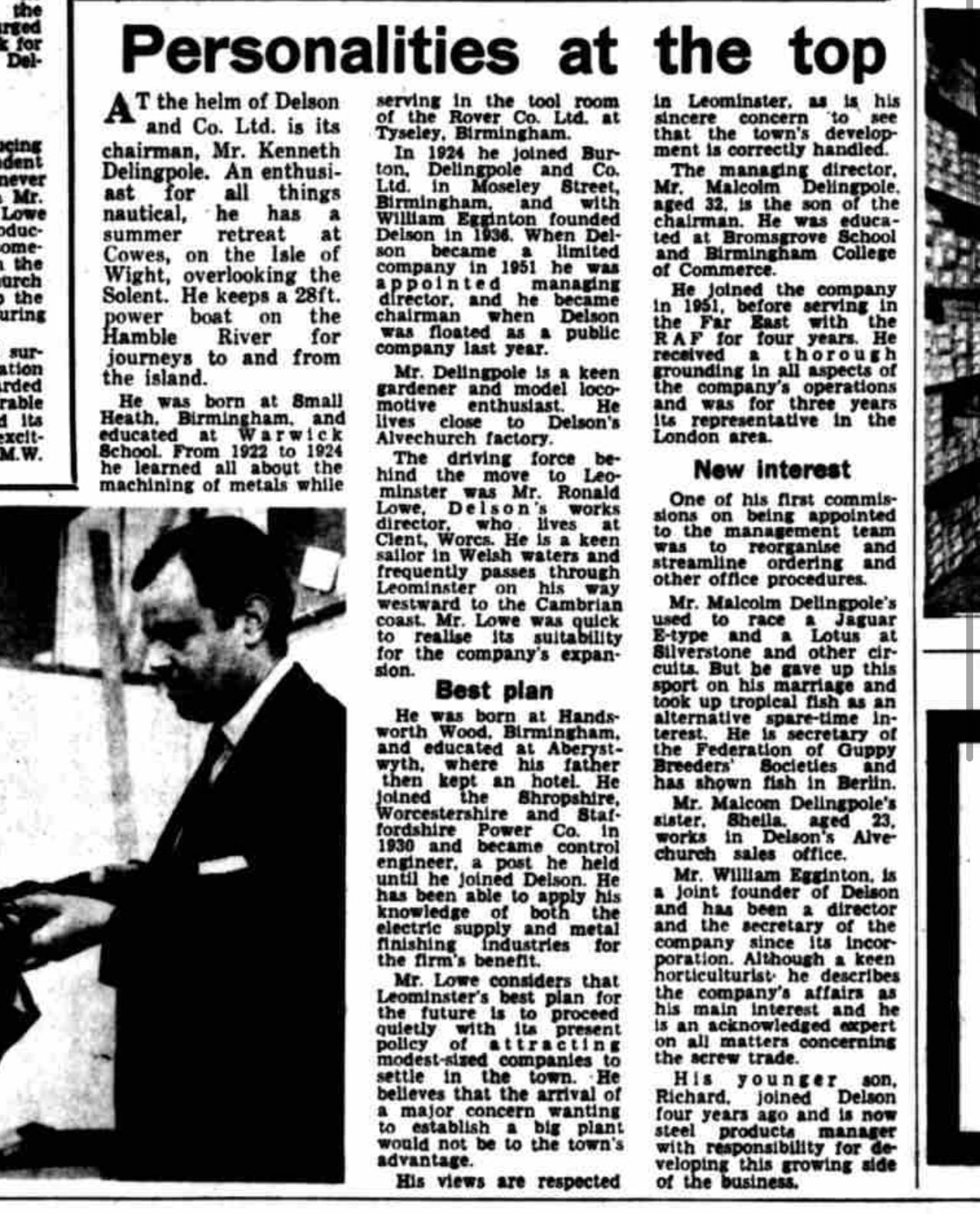


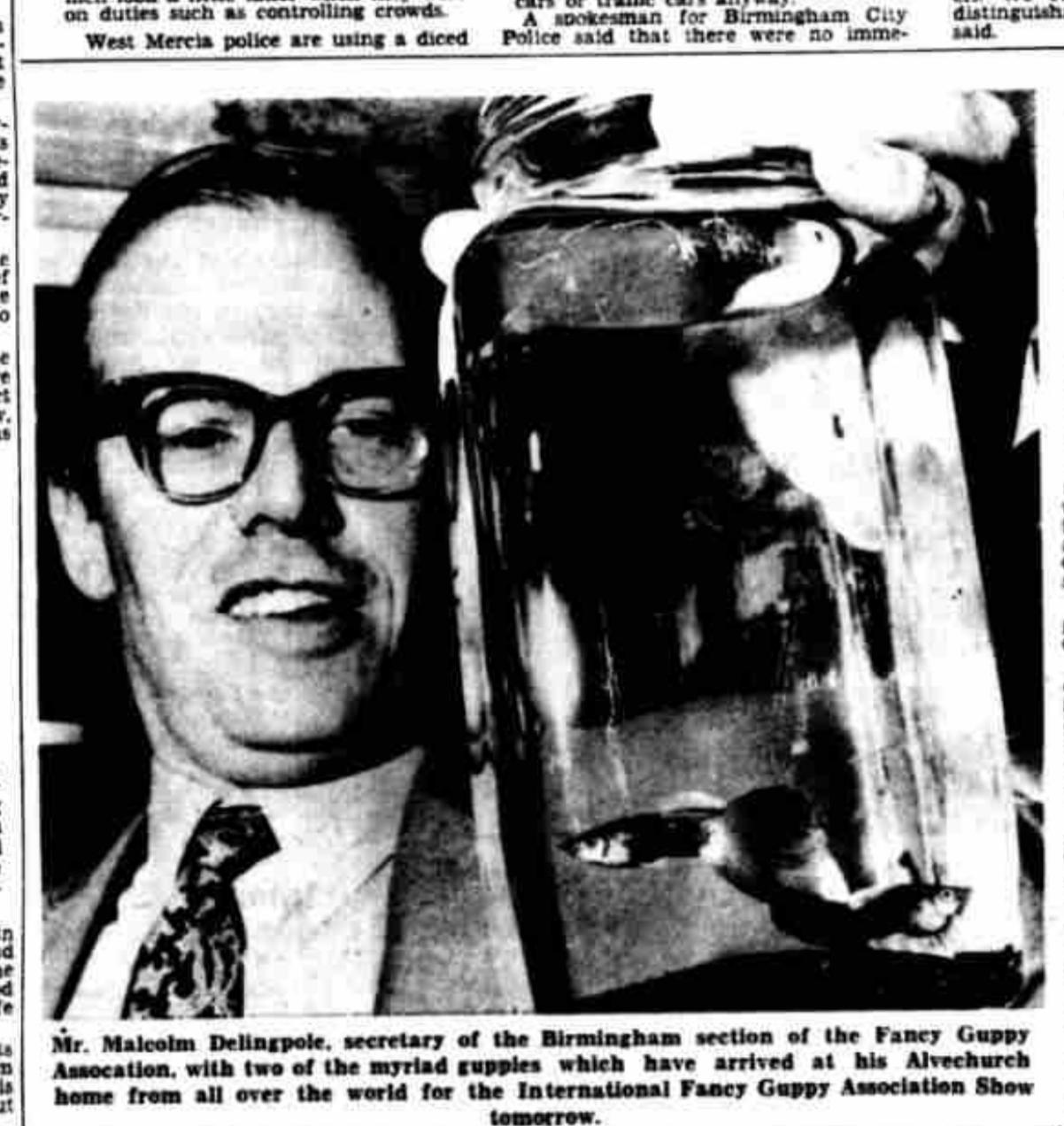
The Family Tree
Five generations of the Delingpole family, as recorded in this memoir. Each person’s notes are drawn from Malcolm’s own words. The fully interactive version lives at delingpole.com/family.html.
Distant ancestors
Distant ancestor
Abraham Wivell b. 1786
A forebear on Grandma Delingpole’s side of the family, and the most colourful name in the older branches of the tree.
Abraham Wivell was a portrait painter who went on to invent the first canvas tubular fire escape — a device that was for a time displayed in the Science Museum, where Malcolm saw it himself.
Malcolm liked to think that Wivell’s artistic genes resurfaced generations later in his son Richard’s painting.
Grandparents’ generation
Great-aunt (William’s sister)
Aunt Maud
William Harry’s sister, who lived in Stratford-on-Avon.
In his later years Grandpa Delingpole would go to “Aunt Maud’s” at the weekends.
Paternal grandfather
William Harry Delingpole b. 13 July
“Grandpa Delingpole” — a spirited, handsome and rather dapper young man in his photographs, and by Malcolm’s account a much stronger character than his own son.
A “ladies’ man” with a sense of humour, he loved cruises, bridge and golf. He and Amy parted soon after Malcolm’s father was born but never divorced; he lived alone in a flat at Pitmaston Court, Edgbaston, Birmingham.
He built up a bolts-and-nuts business in Birmingham with his partner John Burton — Burton Delingpole & Co Ltd. When careless book-keeping drew the Inland Revenue and the directors were sent to Winson Green prison, he wryly called it the time “when I was on the Gold Coast.”
Malcolm remembered him as great company on a motoring tour of Europe in the Allard.
Paternal grandmother
Amy Delingpole née Cotterell
“Grandma Delingpole” — from Malcolm’s point of view an affectionate and kind grandmother, “the kind of granny anyone would love,” though he suspected she was a better grandmother than she had been a mother.
She lived in a bungalow on Pickersleigh Road, Malvern. At the height of the Blitz Malcolm’s parents would leave him with her; she took him up the Malvern Hills to the Kettle Sings café and once to see the Lanchester Marionettes.
Her family line reached back to the painter and inventor Abraham Wivell.
Great-aunt (Amy’s sister)
“Arny O”
Amy’s sister, a former teacher who showed Malcolm’s father the affection his own mother did not. Malcolm felt she was the one “Grandpa Delingpole SHOULD have married.”
Before boarding school Malcolm was sent to “Arny O’s” for coaching; she seemed severe but appeared to like him.
Her house in Hole Lane, off the Bristol Road in Birmingham, was nearly destroyed when a German parachute land-mine lodged in a tree close by and had to be defused.
Great-uncle
William’s brother
A Sergeant Major posted to the West Indies. He struck an officer and was dismissed the service; Grandpa Delingpole used to help him out financially.
Maternal grandfather
Sidney Strong
“Grandpa Strong” — described on Ethel’s birth certificate as a coal merchant. He ran a successful coal-delivery business and the family lived at Eastcote House.
A devoted husband, he could never resist backing slow horses. While the Delingpoles grew richer the Strongs grew poorer, and he eventually lost both the house and the business — everything except his wife. Malcolm’s parents helped fund them in later life.
Malcolm never knew him as well as Grandpa Delingpole, and regretted missing that grandparent bond.
Maternal grandmother
Grandma Strong
Sidney’s devoted wife. The couple were so close that they died within a week of one another.
Malcolm saw little of his mother’s parents and remembered them only faintly, as they died when he was quite young.
Parents’ generation
Joan’s father (in-law)
Arnold Price
Father of Malcolm’s first wife, Joan. With his wife Nancy he came over every Sunday once Malcolm and Joan had married, a routine made all the happier by the arrival of their first grandchild, James.
Joan’s mother (in-law)
Nancy Price
Mother of Joan. She and Arnold were devoted Sunday visitors throughout Malcolm and Joan’s marriage.
Father
Kenneth Court Delingpole “Ken”
Malcolm’s father — always, to Malcolm, a serious man who had his son’s best interests at heart. He came from an argumentative, rather aggressive family and had a lonely childhood after his parents’ marriage broke up; his early home was Eastcote Hall, Warwickshire.
He boarded at Warwick School, which he hated even more than Malcolm would hate his own school, recalling meals of “bread and scratch” — margarine spread on, then scraped off again.
He worked in his father’s firm, and when Grandpa Delingpole was imprisoned he founded a new bolts-and-nuts company, Delson & Co Ltd, in parallel — partly so customers would not desert the “stigmatised” name.
In a reserved occupation making munitions, he still served as an ARP warden and later as a Home Guard corporal, his poor hearing keeping him from rising further.
Mother
Ethel Zillah Strong “Ethel”
Malcolm’s mother — “the most tender mother,” a very pretty woman who, in his earliest years, was a full-time mother to her sickly first-born.
The eldest of the close-knit Strong children, she was born into a family with no money worries — a privilege she never took for granted.
She was a businesswoman too: she co-founded DGS Ltd, which made cotter-pins, the initials standing for Delingpole, Gee and Strong (Strong being her maiden name). The business was later sold to its general manager and renamed A. J. Lees & Co.
Uncle (mother’s brother)
Bill Strong
Ethel’s younger brother, who worked for Malcolm’s father all his life.
Aunt (mother’s sister)
Nora Strong
Ethel’s sister, a Land Girl during the war. She never married and, Malcolm believed, died of sleeping sickness soon after the war ended.
Aunt (mother’s sister)
Mary Strong
Ethel’s younger sister, who also worked in one of the family businesses for a while. The Strongs were a very close family — “when one was wronged they were all wronged.”
Mary’s father (in-law)
Ken Frazier
Father of Malcolm’s second wife, Mary. Malcolm reckoned his son Charlie inherited business instincts from both grandfathers — “Bill” Delingpole on one side and Ken Frazier on the other.
Malcolm’s generation
Sister
Malcolm’s sister b. c.1943
Born when Malcolm was eight, so that for many years he felt like an only child and the adored elder brother — a status that lasted, he joked, right up until he came home from RAF service in Hong Kong.
Her mother-in-law, an interior designer, lavishly decorated Malcolm’s first home with Joan.
First wife
Joan Delingpole née Price
Malcolm’s first wife. They married at Hagley Church with a lavish reception at the Lyttelton Arms, and built a happy early life together — the high point, Malcolm said, being the birth of their first child.
A French teacher, she was keen on tennis and golf and remained, through her grandchildren’s eyes, wonderfully athletic and musical — her granddaughter Poppy idolised her.
The marriage came under strain as Malcolm battled depression over the family business; it ended after Joan formed a relationship with her squash coach. They divorced in 1972, agreeing that Joan would raise Helen and Malcolm the boys.
The author
Malcolm Hugh Delingpole 1935 – 2026
Born on 1 March 1935 in Birmingham, the first-born and for eight years an only child. He was named Malcolm after the racing driver Sir Malcolm Campbell — his father’s hero — whose autograph he later obtained. As a baby he survived pyloric stenosis, operated on at two months old.
After a wartime boarding-school childhood he spent four years in the RAF, much of it in Hong Kong, before rejoining the family fastener business, Delson & Co, in Alvechurch.
He raced a Jaguar E-type and a Lotus at Silverstone, then — famously — swapped the track for breeding prize tropical guppies, becoming secretary of the Federation of Guppy Breeders’ Societies and exhibiting as far afield as Berlin.
Married twice and the father of five children, he wrote this memoir, “My Life,” so that his family and his children’s children would know the world he had lived in. He died, unexpectedly, in March 2026.
Second wife
Mary Delingpole née Frazier
Malcolm had actually known Mary — and her parents — before he ever met Joan. They re-met years later at the NEC in Birmingham, by which time she was divorced with two daughters of her own.
After a famously bumpy start, with five children between them and Mary moving “in and out quite a few times,” they married in a full church wedding in 1977 and made their home at Fairfield, later the Old Rectory.
A keen tennis-player and golfer, she brought daughters Marianne and Emily into the family and had two more children with Malcolm. The marriage met the same business pressures as the first and ended in divorce after Malcolm’s attempt to build a new fastener company failed.
Children
Son (with Joan)
James Delingpole
Malcolm and Joan’s eldest — the long-awaited first child, born at the couple’s open-plan first home.
He read for a degree at Oxford and, though he once thought himself set for a career in the City, his literary gifts made him a writer instead. Malcolm wondered aloud where such skill as a “wordsmith” had come from, freely admitting his son was the better-read of the two.
Son (with Joan)
Richard Delingpole
Malcolm and Joan’s second son. Malcolm rated him a much under-rated artist — wondering whether some of the painter Abraham Wivell’s genes had been passed down the generations — noting that few fine artists can make a living from it.
A keen historical re-enactor, he shares the hobby with his son Oliver.
Daughter (with Joan)
Helen Delingpole
Malcolm and Joan’s third child, born in December two years after Richard. After the divorce she was raised principally by her mother.
She honed her languages at a convent in Hameln — the town of Pied-Piper fame — in Germany; with a French-teacher mother and a father who called himself “a good, if lazy, linguist,” the gift ran in the family.
Son (with Mary)
Charlie Delingpole
One of Malcolm’s two children with Mary. Malcolm thought he had inherited business skills from both his grandfathers — “Bill” Delingpole and Ken Frazier.
Alone among the five children he picked up both of his parents’ sporting passions, tennis and golf.
Daughter (with Mary)
Mary-Rose
Malcolm and Mary’s daughter, with undoubted artistic and organisational talents that her large young family kept her too busy to show off fully.
With her husband Pete she had three little girls — Nina, Holly and Willow.
Mary-Rose’s husband
Pete
Mary-Rose’s husband and father of Nina, Holly and Willow. Malcolm noted that their middle girl, Holly, had “a lot of her father Pete in her.”
Step-daughter
Marianne
Mary’s elder daughter from her first marriage, and so Malcolm’s step-daughter. He felt that growing up with two step-brothers helped her handle every situation when her own boys came along.
Step-daughter
Emily
Mary’s younger daughter from her first marriage. Malcolm counted both his step-children among those he hoped loved and respected him — “and this makes me very happy.”
Grandchildren
Grandson (James’s son)
Ivo
James’s son, a little younger than his cousin Freya. Malcolm recorded that he would be going to Eton, with “the brains and character which will carry him through.”
Grandson (Richard’s son)
Oliver aged 15
Malcolm’s eldest grandchild and, in many ways, the most like Malcolm at the same age — generally pensive.
He enjoys historical re-enactments with his father and once seemed destined for the Army; he hopes one day to teach history, an ambition Malcolm thought admirable.
Granddaughter (Richard’s daughter)
Freya aged 13
Oliver’s sister and quite his opposite. Like her cousin Poppy she seemed destined for Oxbridge “and beyond,” and, like Grandma Joan, was very athletic.
Granddaughter
Poppy aged 10
A granddaughter of the Joan line whom she idolised, inheriting her grandmother’s musical talent and athleticism. Malcolm thought she and her cousin Freya were much alike and both bound for Oxbridge.
(Malcolm doesn’t record which of his children is Poppy’s parent.)
Granddaughter (Mary-Rose’s daughter)
Nina aged 8
The eldest of Mary-Rose and Pete’s three girls, and more like her mother. She endeared herself to Malcolm at once by declaring “Isn’t Grandpa wonderful” — a verdict she never quite repeated, even after the gift of a new bike.
Granddaughter (Mary-Rose’s daughter)
Holly aged 6
The middle of Mary-Rose and Pete’s three girls, with, Malcolm noticed, a lot of her father Pete in her.
Granddaughter (Mary-Rose’s daughter)
Willow aged 4
The youngest of Mary-Rose and Pete’s girls. “We shall have to wait to see who Willow takes after,” wrote Malcolm.